


Top 5 Pension Plans in Kenya (2025 Guide): Securing Your Future

Planning for retirement is no longer a luxury—it’s a necessity, particularly in Kenya. With rising living costs, evolving family support structures, and increasing life expectancy, securing your financial future requires proactive measures. While the National Social Security Fund (NSSF) provides a baseline, private pension plans offer enhanced returns, tax advantages, and greater flexibility. In this comprehensive guide, we’ll explore top pension providers in Kenya, their features, and how to select the best plan to safeguard your retirement.
Key Takeaways
- Private pension plans offer better returns and tax benefits than NSSF alone
- Early saving benefits from compound interest, potentially growing a Ksh 10,000 monthly contribution to Ksh 38 million over 35 years
- Top providers include Old Mutual, Britam, APA Life, Madison, and GA Insurance
- Contributions up to Ksh 20,000 monthly are tax-deductible
- Compare returns, fees, flexibility, and governance when choosing a pension plan
- Step by Step Insurance partners with leading providers to offer customized retirement solutions
Table of Contents
- Why Retirement Planning Matters in Kenya
- Key Factors to Compare Pension Plans
- Top Pension Plans in Kenya (2025): Provider Highlights
- Comparison of the Best Pension Plans
- How Step by Step Partners With Pension Providers
- How to Start a Pension Plan in Kenya
- Tax Benefits of Pension Plans
- Common Mistakes to Avoid
- FAQs About Pension Plans in Kenya
Why Retirement Planning Matters in Kenya
Kenya faces demographic and economic shifts that underscore the urgency of retirement planning. Here are critical points to consider:
- Aging Population: Kenya’s population is aging, increasing the dependency ratio and straining social security systems.
- Inflation: At a current rate of 6.8%, inflation erodes the purchasing power of savings over time.
- NSSF Limitations: NSSF provides limited payouts. As per a report, the maximum payout can reach Ksh 1,080,000 but this lump sum often falls short of retirees’ long-term needs.
- Rising Healthcare Costs: Healthcare expenses tend to increase with age.
- Economic Uncertainties: Job security and economic stability can’t be guaranteed, making personal savings essential.
Private pension plans, regulated by the Retirement Benefits Authority (RBA), offer numerous advantages:
- Compound Interest Growth: Early savings benefit significantly from compounding. For instance, saving Ksh 10,000 per month with a 10% annual return could grow to approximately Ksh 38 million over 35 years.
- Tax Benefits: Contributions are tax-deductible up to Ksh 20,000 per month (Ksh 240,000 annually).
- Flexibility: Adjust contribution amounts, make lump-sum additions, and potentially access funds for emergencies.
Key Factors to Compare Pension Plans
1. Returns and Investment Options
Providers invest funds in various assets, including stocks, bonds, and real estate.
- Old Mutual: Known for diversified portfolios with historical returns surpassing 10%. They offer segregated and guaranteed options.
- APA Life: Guarantees a minimum 4% return, with bonus yields.
Investment strategies vary, impacting potential returns and risk levels.
2. Fees and Charges
Understand all associated fees. These include:
- Management Fees: Usually a percentage of the fund’s value.
- Administration Fees: Charged for managing accounts and providing statements.
- Withdrawal Penalties: Fees for accessing funds before retirement age.
| Provider | Annual Fees | Withdrawal Penalties |
|---|---|---|
| Old Mutual | 1.25% | None |
| Britam | 1.5% | 5% for early exit (depending on plan) |
| Madison | 1.3% | None |
3. Flexibility
Flexibility is crucial to accommodate life changes:
- Contribution Frequency: Providers typically offer monthly, quarterly, or lump-sum contributions.
- Early Access: Some plans allow partial withdrawals for specific needs. APA Life permits members to use up to 60% of their savings as mortgage collateral.
- Portability: Can you transfer your pension if you change jobs?
4. Regulation and Governance
All legitimate pension providers must be approved and regulated by the RBA. This ensures:
- Fund Security: Adherence to investment guidelines that protect members’ savings.
- Transparency: Regular reporting and disclosure of fees, performance, and governance.
Top Pension Plans in Kenya (2025): Provider Highlights
1. Old Mutual Individual Pension Plan
Old Mutual offers an Individual Pension Plan (IPP) designed for personal savings towards retirement.
Key Features:
- Flexibility: Adjust contributions based on your preferences.
- Tax Benefits: Contributions are tax-exempt up to set limits.
- No Penalties for Withdrawal: Access up to 60% for a mortgage loan.
- Consolidation: Consolidate pension benefits from various employers to maximize savings.
Benefits:
- Build a fund to achieve your dreams.
- Cover medical expenses.
- Invest NSSF Tier II contributions.
- High investment returns.
- Cost-efficient planning.
- Competent customer service.
- Prompt payment of claims.
- Free financial education.
- Access to a wide range of financial solutions.
- Flexible retirement plan options.
Fees: 1.25% annual fee of the funds under management.
Suitable for: Individuals aged 18 and above.
Tax-Deductible Contributions: Up to 30% of pensionable salary or a maximum of Kshs 20,000 per month.
2. Britam Retirement Plan
Britam offers flexible retirement plans designed to ensure a consistent source of income while maintaining your lifestyle.
Types of Plans:
- Pension Plan: One-third of the accumulated benefit is paid as a lump sum, with the remaining two-thirds paid as regular income for life.
- Provident Plan: The entire accumulated amount is paid as a single lump sum upon retirement.
Benefits:
- Exponential savings growth with interest.
- Retirement benefits paid according to the option selected.
3. APA Life Individual Pension Plan
APA Life’s Individual Pension Plan (IPP) is a long-term investment plan that helps build a sizeable retirement fund with competitive interest rates.
Why APA IPP?
- Guaranteed Returns: Member’s contributions and earnings are guaranteed against investment loss at a minimum of 4%.
- Bonus Returns: Offers bonus returns in addition to guaranteed interest.
- Risk-Free: Investments risk borne by APA.
- Flexibility: Flexible contributions and withdrawals.
- Mortgage Collateral: Use up to 60% of the fund as collateral for a mortgage.
- No Hidden Costs: Offers no costs of joining or administering the fund.
- Power of Compounding: APA has averaged 10% net investment returns over the last 10 years.
Example:
| Current Age | Years of scheme membership | Monthly contribution | Accumulated contribution at retirement | APA projected average return | Retirement benefits at guaranteed returns (4%) | Retirement benefits average returns (10%) |
|---|---|---|---|---|---|---|
| 25 | 35 | 1,000.00 | 420,000.00 | 10.00 % | 916,776 | 3,828,276 |
| 25 | 35 | 2,000.00 | 840,000.00 | 10.00 % | 1,833,553 | 7,656,553 |
| 25 | 35 | 4,000.00 | 1,680,000.00 | 10.00 % | 3,667,106 | 15,313,106 |
| 25 | 35 | 5,000.00 | 2,100,000.00 | 10.00 % | 4,583,883 | 19,141,383 |
| 25 | 35 | 6,000.00 | 2,520,000.00 | 10.00 % | 6,417,436 | 22,969,660 |
| 25 | 35 | 8,000.00 | 3,360,000.00 | 10.00 % | 7,334,213 | 30,626,213 |
| 25 | 35 | 10,000.00 | 4,200,000.00 | 10.00 % | 9,167,767 | 38,282,767 |
| 25 | 35 | 20,000.00 | 8,400,000.00 | 10.00 % | 18,335,534 | 76,565,534 |
Reporting: Members receive annual benefit statements.
Governance: Managed by a professional independent corporate board of trustees.
4. Madison Personal Pension Plan
Madison Insurance offers a Personal Pension Plan designed to provide retirement, savings, and investment benefits to individuals.
Key Features:
- Specially designed savings plan for retirement.
- Maximizes returns.
- Ideal for individuals and occupational schemes.
Declared Interest Rates:
- 2021: 11%
- 2020: 8%
- 2019: 10%
- 2018: 10%
- 2017: 10%
Premium Payment Modes:
- M-Pesa
- Cheque
- Bank Transfers
- Check-offs for regular contributions
Benefits:
- Ensures a decent standard of living in retirement.
- Contributions up to Kshs. 20,000.00 are tax deductible.
- Members can assign up to 60% of their benefits as security for mortgages.
- Upon death, accumulated funds are paid to beneficiaries immediately.
- Operates under the RBA act.
- Single lump sum contributions allowed.
- Option to buy annuity at retirement.
- Additional cover on life, critical illness, and last expense.
Enrollment:
- Fill a proposal form.
- Provide copies of ID and PIN.
- Pay initial contribution or provide transfer request letter.
5. GA Insurance Personal Pension Plan
GA Insurance’s Personal Pension Plan is a long-term investment designed to help you build a retirement fund.
Who Forms The Scheme? GA Life Assurance Limited established the scheme.
Who Can Join? Employed individuals, self-employed individuals, and SMEs/groups.
How to Join? By completing an application form.
Contributions: You contribute a fixed amount from your salary, and employers can also contribute.
Tax Benefits:
- Monthly contributions are not subjected to PAYE (up to Kshs. 20,000 per month).
- Employers can treat contributions as a tax-allowable expense.
Income from Contributions: Contributions are invested and earn income from the day they are received.
Guaranteed Returns: 100% capital guarantee, with a minimum guaranteed return of 4%.
Fund Value Statements: Members receive monthly statements showing their fund status.
Leaving Job/Moving Jobs:
- 100% of your contributions plus accrued interest is paid to you (less taxes).
- Employer’s contributions are locked until age 50 and can be left in the scheme, moved to a new employer’s scheme, or moved to an individual retirement plan.
Death Benefits: 100% of your contributions and employer’s contributions plus accrued interest is paid to the nominated beneficiary immediately (less taxes).
Incapacity Benefits: 100% of contributions and accrued interest is paid to you.
Early Retirement: You can retire at age 50 and take 1/3rd of the fund as cash, with the remaining 2/3rd converted into a monthly pension.
Comparison of the Best Pension Plans
| Provider | Minimum Contribution | Returns | Unique Perks |
|---|---|---|---|
| Old Mutual | Ksh 1,000/month | 10% (historical) | Mortgage collateral, no withdrawal penalties, consolidation of funds, access to financial advice |
| Britam | Ksh 2,000/month | 8–12% (historical) | Critical illness coverage (optional), variety of investment plans, flexible payment options |
| APA Life | Ksh 1,000/month | 4% (guaranteed) + bonus | Mortgage collateral, no fees, guaranteed returns, high historical average returns |
| Madison | Ksh 1,500/month | 5–11% (historical) | Early retirement option (at 50), additional insurance riders (life, critical illness), option to buy annuity, RBA-regulated |
| GA Insurance | Ksh 5,000/month | 4% (guaranteed) + growth | 100% capital guarantee, monthly fund statements, employer tax benefits, ability to join as an individual or through employer, flexible investment options |
How Step by Step Partners With Pension Providers
At Step by Step Insurance, we’ve established strategic partnerships with Kenya’s leading pension providers to ensure you receive personalized retirement solutions tailored to your unique financial goals. Our independent advisory approach means we work for you, not the providers, giving you access to unbiased recommendations and preferential terms.
Personalized Assessment
Our certified financial advisors conduct comprehensive evaluations of your financial situation, retirement goals, and risk tolerance. This thorough assessment forms the foundation of our recommendations, ensuring the pension plan we suggest aligns perfectly with your long-term objectives.
Negotiated Benefits
Through our established relationships with Old Mutual, Britam, APA Life, Madison, and GA Insurance, we’ve negotiated exclusive benefits for our clients, including reduced management fees, waived administrative charges, and enhanced returns. These partnerships allow us to secure terms that aren’t available to individual applicants.
Streamlined Application Process
We simplify the enrollment process by handling the paperwork, documentation requirements, and coordination with providers. Our team manages the entire application journey, from initial submission to account setup, saving you time and eliminating bureaucratic hassles.
Ongoing Portfolio Management
Our partnership doesn’t end when your pension plan is established. We provide continuous oversight of your retirement portfolio, conducting regular performance reviews, suggesting adjustments when necessary, and keeping you informed about market trends that might impact your investments.
Multi-Provider Strategy
Unlike agents tied to a single provider, Step by Step can recommend pension plans from multiple companies, often creating diversified retirement strategies that combine the strengths of different providers. This approach maximizes returns while minimizing risk through strategic diversification.
Educational Resources
Our partnerships enable us to offer exclusive access to retirement planning workshops, financial literacy seminars, and specialized educational materials developed in collaboration with Kenya’s top pension providers. These resources empower you to make informed decisions about your financial future.
By leveraging our strong relationships with Kenya’s premier pension providers, Step by Step Insurance creates customized retirement solutions that maximize returns, minimize fees, and align perfectly with your financial goals. Our independent advisory approach ensures you receive unbiased recommendations focused solely on securing your financial future.
Schedule Your Free Retirement ConsultationHow to Start a Pension Plan in Kenya
- Assess Your Retirement Goals: Estimate your future living expenses, desired lifestyle, and potential healthcare costs. Aim to save 10-30% of your current income.
- Compare Providers: Utilize the comparison table above and conduct thorough research on each provider.
- Enroll: Complete the application form. You’ll typically need your ID, PIN, and initial contribution.
- Set Up Payments: Automate contributions via M-Pesa, bank transfers, or salary deductions.
- Review Performance Annually: Stay informed about your fund’s performance and make adjustments as needed.
Tax Benefits of Pension Plans
Pension plans in Kenya offer significant tax advantages:
- Contributions: Tax-deductible up to Ksh 20,000 per month (Ksh 240,000 annually), reducing your taxable income.
- Investment Growth: Investment returns within the fund are tax-free.
- Withdrawals: Taxed as follows:
- Lump-sum withdrawals: Subject to taxation based on prevailing tax laws.
- Annuities (regular monthly payments): May be structured to minimize tax liability.
Common Mistakes to Avoid
- Delaying Enrollment: Starting early is critical. The power of compounding means that the earlier you begin, the more your retirement savings will grow.
- Ignoring Fees: High fees can erode your returns over time. Always factor in management, administration, and transaction fees.

The Best Performing Collective Investment Schemes and Fund Managers in Kenya: A 2025 Guide
Collective investment schemes (CIS) have transformed how Kenyans approach wealth management. These pooled funds, professionally managed and invested in diverse financial instruments such as equities, bonds, and money market securities, offer an accessible avenue for both seasoned and novice investors. As of December 2024, the Kenyan CIS sector boasted assets under management (AUM) totaling Ksh 389 billion, a testament to its growing popularity and the increasing financial literacy among Kenyans.
Key Takeaways
- CIS offer diversification and professional management.
- The Kenyan CIS sector has significant assets under management.
- Understanding CIS performance is crucial for informed investment decisions.
Table of Contents
- Understanding Collective Investment Schemes in Kenya
- What Are Collective Investment Schemes?
- Why Are CIS Popular in Kenya?
- Top Performing Investment Schemes in Kenya (December 2024 Rankings)
- Market Leaders by AUM
- Key Insights from the Rankings
- Factors Driving Performance of Top Investment Schemes Managers
- Investment Portfolio Composition
- Firm Size and Market Reach
- Regulatory Compliance
- Comparing Returns Across CIS Managers
- Understanding Annual Rates vs. Net Returns
- Insights for Investors
- Emerging Trends in Kenya’s CIS Industry
- Growth of Technology Integration
- Focus on Sustainable Investments
- How to Choose the Right Investment Scheme
- Key Factors to Consider
- Practical Tips for Investors
- FAQs About Investment Schemes in Kenya
- What is the minimum investment amount for CIS?
- How do I withdraw my money from a CIS?
- How are CIS taxed in Kenya?
- Conclusion
This article aims to dissect the performance of various CIS in Kenya, focusing on market share, growth rates, and overall returns. We’ll explore which schemes stood out in 2024, providing you with valuable insights to make informed investment decisions.
Understanding Collective Investment Schemes in Kenya
What Are Collective Investment Schemes?
A collective investment scheme is essentially a pool of funds collected from many investors to invest in stocks, bonds, money market instruments, and other assets. These schemes are managed by professional fund managers who make investment decisions on behalf of the investors. The value of an investor’s stake in the CIS is determined by the performance of the underlying assets.
The advantages of investing in CIS include:
- Diversification: By pooling funds, CIS can invest in a wide array of assets, reducing the risk associated with holding a few investments.
- Professional Management: Fund managers possess the expertise and resources to analyze market trends and make informed investment choices.
- Accessibility: Many CIS require relatively low minimum investment amounts, making them accessible to a broad range of investors.
- Liquidity: Investors can typically redeem their units within a few business days, offering greater flexibility compared to less liquid investments like real estate.
Why Are CIS Popular in Kenya?
Several factors contribute to the increasing appeal of CIS in Kenya:
- Growing Middle Class: Kenya’s expanding middle class seeks avenues to grow their wealth beyond traditional savings accounts.
- Regulatory Oversight: The Capital Markets Authority (CMA) plays a crucial role in regulating CIS, ensuring transparency and investor protection, which in turn boosts investor confidence.
- High Liquidity: Compared to other investment options, such as property or fixed deposits, CIS offer relatively high liquidity, allowing investors to access their funds when needed.
- Competitive Returns: CIS often provide higher returns than traditional savings accounts, making them an attractive option for those looking to grow their wealth. For a deeper dive, consider exploring the top money market funds in Kenya.
Top Performing Investment Schemes in Kenya (December 2024 Rankings)
Market Leaders by AUM
Based on data as of December 31, 2024, here’s a snapshot of the market share of the leading CIS in Kenya:
| Rank | Fund Name | Dec 2024 AUM (Ksh) | % Market Share | % Change from Sep 2024 |
|---|---|---|---|---|
| 1 | CIC Unit Trust Scheme | 82.497 billion | 21% | +17% |
| 2 | Sanlam Unit Trust Scheme | 62.749 billion | 16% | +34% |
| 3 | Mansa X Special Fund | 41.697 billion | 11% | +22% |
| 4 | NCBA Unit Trust Scheme | 39.331 billion | 10% | +19% |
| 5 | Britam Unit Trust Scheme | 29.283 billion | 8% | +5% |
| 6 | ICEA Unit Trust Scheme | 19.282 billion | 5% | +13% |
| 7 | ABSA Unit Trust Scheme | 14.898 billion | 4% | +18% |
| 8 | Old Mutual Unit Trust Scheme | 14.102 billion | 4% | +6% |
| 9 | Coop Unit Trust Scheme | 13.530 billion | 3% | +35% |
| 10 | KCB Unit Trust Scheme Limited | 9.321 billion | 2% | +68% |
| 11 | Jubilee Unit Trust Scheme | 8.942 billion | 2% | +76% |
| 12 | Madison Unit Trust Funds | 8.361 billion | 2% | +13% |
| 13 | Nabo Africa Funds | 6.909 billion | 2% | +16% |
| 14 | Etica Capital Limited | 6.616 billion | 2% | +44% |
| 15 | Dry Associates Unit Trust | 5.157 billion | 1% | +16% |
| 16 | Zimele Unit Trust Scheme | 3.244 billion | 1% | +12% |
| 17 | Lofty Corban Unit Trust Scheme | 2.889 billion | 1% | +33% |
| 18 | Mali Money Market Fund | 2.796 billion | 1% | +1% |
| 19 | Stanbic Unit Trust Scheme | 2.437 billion | 1% | +621% |
| 20 | Apollo Unit Trust Scheme | 2.428 billion | 1% | +20% |
| 21 | Gen Africa | 2.389 billion | 1% | +39% |
| 22 | Ziidi Money Market Fund | 1.713 billion | 0.4% | N/A |
| 23 | Cytonn Unit Trust Fund | 1.700 billion | 0.4% | +10% |
| 24 | African Alliance Kenya Unit Trust | 1.616 billion | 0.4% | +6% |
| 25 | Kuza Asset Management Ltd | 1.264 billion | 0.3% | +57% |
| 26 | Faida Unit Trust Scheme | 927.774 million | 0.2% | N/A |
| 27 | Enwealth Capital Unit Trust | 866.797 million | 0.2% | +26% |
| 28 | Genghis Unit Trust Funds | 776.258 million | 0.2% | +1% |
| 29 | Arvocap Unit Trust Funds | 537.676 million | 0.1% | +216% |
| 30 | Orient Collective Investment | 296.873 million | 0.1% | +11% |
| 31 | Faulu Unit Trust Scheme | 253.178 million | 0.1% | +6% |
| 32 | Equity Investment Bank | 119.458 million | 0.03% | -14% |
| 33 | Mayfair Unit Trust Scheme | 117.708 million | 0.03% | +88% |
| 34 | Taifa Unit Trust Scheme | 52.338 million | 0.01% | +342% |
| 35 | Amana Unit Trust Funds | 27.610 million | 0.01% | +2% |
| 36 | MyXeno Unit Trust Scheme | 14.894 million | 0.0038% | +14% |
| 37 | Wanafunzi Unit Trust Scheme | 906.738 thousand | 0.0002% | +2% |
Key Insights from the Rankings
- CIC Unit Trust Scheme’s Dominance: With an AUM of Ksh 82.497 billion, CIC Unit Trust Scheme holds a commanding 21% of the market share. This success can be attributed to its diversified investment portfolios, consistent returns, and strong brand reputation among Kenyan investors.
- Sanlam’s Impressive Growth: Sanlam Unit Trust Scheme showcased remarkable growth, increasing its AUM by 34% to reach Ksh 62.749 billion. This growth indicates Sanlam’s ability to attract new investors and effectively manage its existing portfolios.
- Emerging Players: Mansa X Special Fund, with an AUM of Ksh 41.697 billion, is an emerging player making significant strides in the market. Its innovative investment strategies and focus on specific sectors have contributed to its increased market presence.
- ABSA Unit Trust Scheme Rise: ABSA Unit Trust Scheme also rose by 18%
- Taifa Unit Trust Scheme Rise: Taifa Unit Trust Scheme rose by 342%
Factors Driving Performance of Top Investment Schemes Managers
Investment Portfolio Composition
The composition of a CIS’s investment portfolio is a critical factor influencing its performance. Funds that allocate a significant portion of their assets to equities tend to achieve higher returns during bullish market conditions. Conversely, those with a higher allocation to fixed-income securities, such as bonds, offer greater stability during market downturns.
Money market funds have also gained popularity in Kenya due to their relatively low risk and high liquidity. These funds invest in short-term debt instruments, making them a safe haven during uncertain economic times.
Firm Size and Market Reach
Larger CIS managers, such as CIC Unit Trust Scheme and Sanlam Unit Trust Scheme, benefit from economies of scale. Their substantial AUM allows them to negotiate lower transaction fees, diversify their portfolios more effectively, and invest in sophisticated research and technology. Additionally, their extensive branch networks and marketing capabilities enable them to reach a broader investor base.
Regulatory Compliance
The regulatory environment plays a vital role in shaping the performance of CIS in Kenya. The CMA’s oversight ensures transparency, accountability, and adherence to best practices, fostering investor confidence and attracting both local and foreign capital. For further reading on regulatory compliance, you might find this guide on top insurance companies in Kenya relevant.
Comparing Returns Across CIS Managers
Understanding Annual Rates vs. Net Returns
When evaluating the performance of CIS, it’s essential to consider both the annual rates and the net returns. The annual rate represents the total return earned by the fund before deducting any fees or expenses. In contrast, the net return reflects the actual return received by investors after accounting for all applicable charges, including management fees, trustee fees, and administrative expenses.
Insights for Investors
While funds with higher annual rates may appear more attractive, it’s crucial to focus on net returns, as they provide a more accurate representation of the profitability of the investment. Investors should also compare the fees charged by different funds to ensure they are receiving competitive value.
Emerging Trends in Kenya’s CIS Industry
Growth of Technology Integration
Technology is playing an increasingly significant role in the CIS industry in Kenya. Digital platforms like M-PESA are enabling easier access to investment products, particularly for retail investors. Online dashboards for portfolio tracking, mobile apps for account management, and robo-advisors offering personalized investment recommendations are becoming increasingly common.
Focus on Sustainable Investments
Environmental, social, and governance (ESG) factors are gaining prominence in the Kenyan investment landscape. Investors are increasingly seeking out CIS that prioritize sustainable business practices, promote social responsibility, and adhere to ethical governance standards. This trend is driven by a growing awareness of the link between responsible investing and long-term financial performance.
How to Choose the Right Investment Scheme
Key Factors to Consider
Selecting the right CIS requires careful consideration of several factors:
- Fund Reputation: Research the fund manager’s track record, investment philosophy, and transparency practices.
- Investment Goals: Determine your investment objectives, risk tolerance, and time horizon.
- Short-term liquidity needs: Money market funds are ideal.
- Long-term growth: Equity-heavy portfolios offer greater potential returns.
- Fees: Compare management fees, trustee fees, and other expenses across different funds to maximize net returns.
- Investment Options: What investment choices can you make to earn well? What are the fees?
- Historical Rates: Do your due diligence about the fund by checking for historical rate
- Liquidity: What are the options of withdrawing your funds?
- Terms: What are the underlying fine print terms for joining?
Practical Tips for Investors
- Start Small: Begin with funds offering low minimum investments to gain experience and build confidence.
- Diversify: Allocate your investments across different CIS to reduce risk.
- Regularly Review: Monitor your fund’s performance and adjust your portfolio as needed to align with changing financial goals.
- Seek Professional Advice: Consult with a financial advisor to receive personalized recommendations based on your individual circumstances.
FAQs About Investment Schemes in Kenya
What is the minimum investment amount for CIS?
Most funds require as little as Kshs. 1,000, making them accessible to many Kenyans. Some funds even go lower.
How do I withdraw my money from a CIS?
Withdrawals typically take between one and three business days, depending on the fund manager. Many fund managers now offer same-day or next-day withdrawals for added convenience.
How are CIS taxed in Kenya?
Interest income earned from money market funds and fixed-income funds is subject to withholding tax at a rate of 15%. Capital gains tax is not applicable to CIS investments.
Conclusion
Investment schemes in Kenya have transformed the investment landscape, offering accessible, professionally managed investment solutions to a wide range of investors. As the market continues to evolve, staying informed about the top-performing funds, emerging trends, and key considerations will be essential for making successful investment decisions.
Whether you are a seasoned investor or just starting out, understanding the dynamics of the Kenyan CIS industry will empower you to achieve your financial goals.

Best Health Insurance Plans for Kids in Kenya: Top Providers in 2025
In Kenya, where healthcare costs can spiral unexpectedly, securing health insurance for your child is a proactive step toward safeguarding their well-being. With rising cases of childhood illnesses like pneumonia, malaria, and congenital disorders, having a dedicated health plan ensures your child receives timely care without financial stress.
- Understanding Child-Only Health Insurance
- Top 4 Health Insurance Providers for Kids in Kenya
- Head-to-Head Comparison of All Providers
- Step by Step Insurance: Your Partner in Tailored Solutions
- SHA vs. Private Insurance: A Cost-Benefit Analysis
- 5-Step Checklist for Choosing the Best Plan
- Final Call to Action
Understanding Child-Only Health Insurance
Child-only health insurance covers medical expenses for minors, typically from birth (37+ weeks) to age 17–25 (if enrolled in school). These plans focus on pediatric needs, including:
- Preventive care: Vaccinations, wellness checkups, and developmental screenings.
- Emergency care: Accident injuries, surgeries, and hospital admissions.
- Chronic conditions: Asthma, diabetes, and congenital disorders.
Top 4 Health Insurance Providers for Kids in Kenya
We analyze Kenya’s leading insurers, their plans, costs, and unique benefits.
1. APA Insurance: Affordable Tiered Coverage
APA offers two plans tailored to different budgets:
a) APA Jamii Plus
- Inpatient: KSh 500,000 – KSh 10 million.
- Outpatient: KSh 50,000 – KSh 200,000.
- Special Features: Covers congenital conditions (up to sublimits), Tier 1 hospital access (copayment: KSh 500–1,000), Dental (KSh 10,000) and optical (KSh 30,000).
- Cost: From KSh 20,389/year.
b) APA Afya Nafuu
- Inpatient: KSh 100,000 – KSh 1 million.
- Outpatient: KSh 30,000 – KSh 100,000.
- Hospitals: Tier 2/3 facilities (no copayment except Jocham: KSh 500).
- Cost: From KSh 6,115/year.
| Feature | Jamii Plus | Afya Nafuu |
|---|---|---|
| Inpatient Limit | Up to KSh 10M | Up to KSh 1M |
| Outpatient Limit | Up to KSh 200K | Up to KSh 100K |
| Hospital Tier Access | Tier 1–3 | Tier 2–3 |
| Copayment | KSh 500–1,000 | None (except Jocham) |
| Best For | Comprehensive care | Basic coverage |
2. Britam Insurance: Flexible Plans with Last-Expense Support
Britam’s Milele Junior series includes four tiers:
a) Milele Juniors Advantage (Premium)
- Inpatient: KSh 500,000 – KSh 5 million (no sublimits for chronic conditions).
- Outpatient: KSh 50,000 – KSh 150,000.
- Perks: Free annual checkups, critical illness coverage, last-expense benefit (KSh 50,000).
- Cost: From KSh 35,346/year.
b) Milele Junior Essential 1/2 (Budget)
- Inpatient: KSh 500,000 – KSh 5 million (sublimits apply).
- Outpatient: KSh 50,000 – KSh 100,000.
- Hospitals: Tier 2/3 and mission hospitals.
- Cost: From KSh 13,899/year.
| Feature | Advantage | Essential 1 | Essential 2 |
|---|---|---|---|
| Inpatient Limit | Up to KSh 5M | Up to KSh 5M | Up to KSh 5M |
| Chronic Conditions | Full coverage | Sublimits apply | Sublimits apply |
| Hospital Access | Tier 1–3 | Tier 2–3 | Mission hospitals |
| Last-Expense Benefit | KSh 50,000 | KSh 50,000 | KSh 50,000 |
| Cost | From KSh 35,346 | From KSh 15,643 | From KSh 13,899 |
3. Jubilee Health Insurance: High-Coverage Safety Net
JCare Junior offers Kenya’s highest inpatient limits:
- Inpatient: Up to KSh 10 million.
- Outpatient: KSh 50,000 – KSh 200,000.
- Specialized Care: Mental health counseling, physical therapy.
- Copayment: KSh 1,000–2,000 at select Tier 1 hospitals.
- Cost: From KSh 21,316/year.
Key Fact: Jubilee processes claims in 5 days on average, faster than competitors.
4. Old Mutual: Exclusive Pediatric Hospital Access
Old Mutual partners with Gertrude’s Children’s Hospital for specialized care:
a) Unlimited Panel
- Inpatient: KSh 500,000 – KSh 5 million.
- Outpatient: KSh 50,000 – KSh 150K (includes dental/optical).
- Cost: From KSh 32,954/year.
b) Gertrude’s Only
- Same coverage but restricted to Gertrude’s Hospital.
- No copayments for outpatient visits.
- Cost: From KSh 29,538/year.
| Feature | Unlimited Panel | Gertrude’s Only |
|---|---|---|
| Hospital Access | 200+ facilities | Gertrude’s only |
| Copayment | KSh 500–2,000 | None |
| Vaccinations | Covered until age 5 | Covered until age 5 |
| Best For | Nationwide access | Specialist care |
Head-to-Head Comparison of All Providers
| Feature | APA | Britam | Jubilee | Old Mutual |
|---|---|---|---|---|
| Max Inpatient Limit | KSh 10M | KSh 5M | KSh 10M | KSh 5M |
| Outpatient Limit | KSh 200K | KSh 150K | KSh 200K | KSh 150K |
| Chronic Conditions | Sublimits | Full (premium only) | Sublimits | Sublimits |
| Copayment Range | KSh 0–1,000 | KSh 500–1,500 | KSh 0–2,000 | KSh 0–2,000 |
| Avg. Cost/Year | KSh 6K–20K | KSh 14K–35K | KSh 21K+ | KSh 29K–33K |
| Unique Perk | Congenital coverage | Last-expense benefit | Fast claims | Gertrude’s access |
Step by Step Insurance: Your Partner in Tailored Solutions
Step by Step Insurance simplifies choosing the right plan by:
- Comparing All Options: They analyze coverage, costs, and hospital networks.
- Highlighting Sublimits: Ensuring no surprises for pre-existing conditions.
- Simplifying Enrollment: Handling paperwork and claims support.
How They Work with Each Provider
- APA: Custom quotes for Jamii Plus/Afya Nafuu.
- Britam: Explaining last-expense benefits and plan tiers.
- Jubilee: Clarifying high-limit coverage for critical care.
- Old Mutual: Securing direct billing at Gertrude’s Hospital.
Get a Free Quote Tailored to Your Child’s Needs → Click Here
SHA vs. Private Insurance: A Cost-Benefit Analysis
| Feature | SHA Child Plan | Private Insurance |
|---|---|---|
| Monthly Cost | KSh 500 | KSh 500–3,000 |
| Inpatient Limit | KSh 300,000/year | Up to KSh 10M |
| Chronic Conditions | Excluded | Covered (sublimits apply) |
| Hospital Access | Public hospitals | Tier 1–3 facilities |
| Claim Speed | 14–30 days | 3–10 days |
Tip: Combine SHA with a low-cost private plan (e.g., APA Afya Nafuu) for broader coverage.
5-Step Checklist for Choosing the Best Plan
- Assess Medical History: Does your child have pre-existing conditions?
- List Preferred Hospitals: Ensure they’re in-network.
- Compare Outpatient Limits: Vaccines and checkups add up.
- Review Sublimits: For asthma, diabetes, etc.
- Calculate Total Costs: Premiums + copayments.
Final Call to Action
Don’t leave your child’s health to chance. Let Step by Step Insurance match you with a plan that fits your budget and needs. Click below for a free, no-obligation quote:
Start Your Child’s Health Protection Now → Click Here
This guide equips Kenyan parents with the tools to make informed decisions, using detailed comparisons and real-world insights. By prioritizing your child’s health today, you secure their tomorrow.

Securing Kenya’s Economic Backbone How Index-Based Insurance Protects the Informal Sector
In Kenya’s vibrant economy, the informal sector stands as its true backbone, employing approximately 83% of the workforce. From street vendors and motorcycle taxi operators to small-scale farmers and artisans, these workers form the lifeblood of the nation’s economic activity. However, this vital segment operates with minimal financial safety nets, leaving millions vulnerable to sudden shocks like natural disasters, economic downturns, and health emergencies. A promising solution has emerged in the form of index-based insurance (also called parametric insurance), an innovative approach that offers pre-specified payouts based on trigger events rather than requiring proof of individual losses. This article explores how this revolutionary insurance model is being adapted to provide critical financial resilience to Kenya’s informal sector workers, the progress made so far, and the path forward to wider implementation.
Key Takeaways
- Index-based insurance offers pre-specified payouts triggered by events rather than individual loss assessments, making it ideal for informal sector workers.
- Kenya has pioneered innovative programs like Kilimo Salama (now ACRE Africa) and government-backed initiatives for livestock and crop insurance.
- These insurance models improve financial resilience, access to credit, and protection against climate change for informal workers.
- Challenges include basis risk, premium affordability, limited awareness, and data constraints.
- Technology integration through mobile money, remote sensing, and biometric identification is crucial for successful implementation.
Table of Contents
- Understanding Index-Based Insurance
- Key Features of Index-Based Insurance
- The Evolution of Index-Based Insurance in Kenya
- Government-Backed Initiatives
- Extending the Model to Urban Informal Workers
- Benefits for Kenya’s Informal Sector Workers
- Challenges and Implementation Hurdles
- Leveraging Technology for Scale and Impact
- The Path Forward: Policy Recommendations
- Conclusion
Understanding Index-Based Insurance: A New Paradigm for Risk Management
Index-based insurance represents a fundamental shift from traditional insurance models. Unlike conventional insurance that indemnifies actual losses after they occur, parametric insurance offers pre-specified payouts based on trigger events, covering the probability of a loss-causing event happening rather than the specific losses incurred. This approach eliminates the need for time-consuming loss assessments and claim verifications.
The concept is particularly well-suited for addressing risks that affect large populations simultaneously, such as natural catastrophes, but it can also be effectively applied to other emerging risks where reliable data is available and can be analyzed. For Kenya’s informal sector workers, who face a range of trigger events including climate-related disasters, sudden economic downturns, political disruptions, and income loss, this model offers a promising path toward financial security.
Key Features of Index-Based Insurance
Index-based insurance products have several distinctive characteristics that make them particularly suitable for informal sectors:
| Feature | Description | Benefit |
|---|---|---|
| Trigger-based payouts | Compensation is released automatically when predetermined triggers are hit | No need for proof of individual losses |
| Rapid disbursement | Funds quickly disbursed when trigger events occur | Immediate financial relief when most needed |
| Reduced administrative costs | Elimination of individual loss assessments | More affordable premiums |
| Objective and transparent | Payouts based on measurable indices | Reduced disputes and increased trust |
| Technology integration | Leverages mobile money, satellite data, and automated systems | Efficient delivery mechanisms |
The Evolution of Index-Based Insurance in Kenya
Kenya has been at the forefront of index-based insurance innovation in Africa, with pilot projects dating back to 2009. The insurance regulatory framework has been supportive of developing these products, with draft regulations specifically addressing index-based insurance.
The earliest successful implementation was Kilimo Salama (now ACRE Africa), which launched in 2009 to protect small-scale farmers against unpredictable weather events. This program utilized mobile technology and weather stations to monitor conditions and automatically trigger payments when adverse weather occurred. By 2017, it had expanded to cover over 70,000 farmers with coverage against drought, excess rain, and storms, providing protection for seeds, chemicals, and harvest outputs.
Government-Backed Initiatives
Recognizing the potential of this approach, the Kenyan government has supported several major index-based insurance programs:
| Program | Launch Date | Target Group | Key Features |
|---|---|---|---|
| Kenya Livestock Insurance Programme (KLIP) | October 2015 | Pastoralists in Turkana and Wajir | Uses satellite data to monitor vegetation and trigger drought payouts |
| Kenya Crop Insurance Programme (KCIP) | March 2016 | Small-scale maize and wheat farmers | Area yield index insurance with 50% premium subsidy |
| Agricultural Insurance Programme | 2018 | Broader agricultural sector | Public-Private Partnership model with government support |
Extending the Model to Urban Informal Workers
While agricultural index insurance has shown promising results, extending similar protections to urban informal workers presents both opportunities and challenges. The urban informal sector faces different risk profiles, including economic downturns, political disruptions, and health emergencies.
Recent initiatives are exploring how to adapt the index-based model to address these needs. For instance, UNDP’s Insurance Innovation Challenge is supporting innovative insurance products aimed at providing affordable health coverage to low-income groups, especially women in rural areas.
Benefits for Kenya’s Informal Sector Workers
Index-based insurance offers several unique advantages for informal sector workers:
Financial Resilience Against Catastrophic Events
For small-scale entrepreneurs and informal workers operating on thin margins, a single catastrophic event can wipe out years of progress. Index-based insurance provides a safety net that releases funds precisely when most needed, helping maintain business continuity and prevent devastating slides into poverty.
Improved Access to Credit and Investment Opportunities
Insurance coverage reduces risk profiles, potentially unlocking access to formal credit markets. Financial institutions are more willing to lend to insured businesses, knowing that loan repayment capacity is protected against major shocks. This can stimulate investment and growth in the informal sector.
Reduced Vulnerability to Climate Change
For the agricultural segment of the informal economy, which remains highly vulnerable to increasingly unpredictable weather patterns, index insurance specifically designed around climate parameters provides crucial protection.
Health Protection Through Innovative Models
Health-related financial shocks represent a major vulnerability for informal workers. The National Hospital Insurance Fund (NHIF) enrollment is currently mandatory for formal sector workers but voluntary for the informal sector. Index-based approaches could complement these efforts by providing specific health-related coverages with simplified qualification requirements.
Challenges and Implementation Hurdles
Despite its promise, index-based insurance faces several challenges in achieving widespread adoption:
| Challenge | Description | Potential Solutions |
|---|---|---|
| Basis Risk Concerns | Possibility that policyholders experience losses but don’t receive compensation because the index wasn’t triggered | Improved index design, hybrid models, backup safety nets |
| Premium Affordability | Informal workers often operate with minimal margins and irregular income | Government subsidies, micropayments, bundled products |
| Education and Awareness | Limited understanding of how insurance works | Financial literacy programs, simple product design |
| Data Limitations | Need for reliable, long-term data to establish triggers and pricing | Public-private data sharing, technology investments |
Leveraging Technology for Scale and Impact
Technology plays a crucial role in making index-based insurance viable for the informal sector:
| Technology | Application | Impact |
|---|---|---|
| Mobile Money Integration | Delivery platform for micro-insurance products | Enables micro-premiums in small, frequent installments |
| Remote Sensing and Data Analytics | Satellite data and automated weather stations | Objective measurements without expensive on-ground assessments |
| Biometric Identification | Secure identification systems | Efficient verification, reduced fraud, lower administrative costs |
The Path Forward: Policy Recommendations
To maximize the impact of index-based insurance for Kenya’s informal sector, several policy approaches should be considered:
- Blended financing models: Government premium subsidies, particularly for the most vulnerable workers, combined with private sector capital can make coverage more affordable while building sustainable markets.
- Regulatory framework development: Continuing to refine regulations specific to index-based products, including consumer protection provisions, will create an enabling environment for innovation.
- Bundled approaches: Insurance can be bundled with other services like credit, savings, inputs, or mobile services to increase perceived value and improve uptake.
- Public-Private Partnerships: Following the successful model of agricultural programs, PPPs that leverage government support (data, mobilization, subsidies) alongside private sector expertise offer a promising pathway to scale.
Conclusion
Index-based insurance represents a promising innovation with significant potential to strengthen financial resilience across Kenya’s informal sector. While not a perfect solution—no insurance product eliminates all risk—parametric approaches offer practical benefits that address many limitations of traditional insurance models.
The evolution from agricultural pilots to more diverse applications shows how this model can adapt to different contexts. With continued innovation, supportive policies, and technology integration, index-based insurance could become a cornerstone of financial inclusion strategies, protecting the economic backbone of Kenya and preserving livelihoods against an increasingly unpredictable future.

Top Performing Insurance Companies in Kenya: Best at Claims Payment (2025 Rankings)
When shopping for insurance, most consumers focus on premium costs and coverage limits, often overlooking one of the most critical factors: how efficiently companies pay claims. A company’s claims payment ratio – the proportion of claims paid relative to total actionable claims – reveals much about their reliability when you need them most. This comprehensive analysis examines Kenya’s insurance landscape in 2024-2025, highlighting companies that excel at keeping their promises during the critical moment of claim settlement.
Key Takeaways
- Heritage Insurance led Q1 2024 with a 14.89% claim payment ratio
- Madison Insurance showed remarkable improvement, rising to 19.79% in Q2 2024
- Sanlam Insurance demonstrated consistent performance across all quarters
- Digital transformation significantly improves claims processing efficiency
- Choosing insurers with high payment ratios ensures better service when you need it most
Table of Contents
- Why Claims Payment Efficiency Matters
- Kenya’s Insurance Industry Overview (2024-2025)
- Top Performing Companies in Q1 2024
- Q2 2024: Shifting Performance in Claims Settlement
- Q3 2024: Consistent Performers in Claims Payment
- Key Insights from Claims Payment Trends
- What Makes These Top-Performing Companies Stand Out
- How to Choose an Insurer Based on Claims Payment Efficiency
- Step by Step Insurance: Connecting You with Top-Performing Insurers
- Conclusion: The Value of Claims Payment Efficiency
Why Claims Payment Efficiency Matters in Insurance
Insurance is fundamentally a promise to provide financial protection when disaster strikes. The true test of an insurer’s value isn’t how affordable their premiums are or how persuasive their marketing campaigns might be – it’s how reliably they fulfill their obligations when policyholders file claims.
The claims payment ratio represents the percentage of claims an insurer pays relative to the total number of actionable claims during a specific period. According to the Insurance Regulatory Authority (IRA), this metric is calculated by dividing the number of claims paid by the total number of claims actionable during the quarter.
A high claims payment ratio indicates several important qualities:
- Financial stability: The insurer has sufficient reserves to meet obligations
- Efficient claims processing: Their systems and staff handle claims promptly
- Customer-first philosophy: The company prioritizes policyholder needs
- Ethical business practices: The insurer isn’t looking for ways to avoid payouts
According to the IRA’s Q1 2024 report, “In Q1 2024, the claims payment ratio for general liability claims decreased to 8.86% from 10.89% recorded in Q4 2023 with respect to number while it increased to 13.69% from 13.45% recorded in Q4 2024 with regard to amount.” This provides important context for understanding the broader industry trends.
Kenya’s Insurance Industry Overview (2024-2025)
Kenya’s insurance sector continues to evolve, with the IRA reporting that long-term actionable claims in Q1 2024 were 154,153 claims amounting to KES 30.59 billion – an increase in number but a decrease in amount from 147,053 claims amounting to KES 30.70 billion reported in Q4 2023.
For general insurance, liability claims intimated or revived reported in Q1 2024 were 17,545 claims, a decrease from 18,154 claims but an increase in amount from KES 3.14 billion in Q4 2023 to KES 3.50 billion reported in Q1 2024. Meanwhile, 2,450,510 non-liability claims amounting to KES 15.61 billion were reported as intimated or revived, an increase in both number and amount from the previous quarter.
These figures demonstrate the significant volume of claims processed by Kenya’s insurance industry, highlighting the importance of selecting companies that can efficiently manage this workload while maintaining high payment standards.
Top Performing Companies in Q1 2024: Claims Payment Champions
The first quarter of 2024 established clear leaders in claims payment efficiency. According to the data, Heritage Insurance dominated with an impressive 14.89% claim payment ratio, nearly double its nearest competitor. This reflects Heritage’s commitment to prompt claim settlement and streamlined processing systems that prioritize customer satisfaction during what can often be stressful circumstances.
| Company | Claims Payment Ratio (Q1 2024) | Key Strengths |
|---|---|---|
| Heritage Insurance | 14.89% | Fast processing, excellent customer service |
| Madison Insurance | 7.85% | Responsive claim handlers, clear documentation |
| APA Insurance | 3.85% | Digital claims tracking, transparent process |
| Sanlam Insurance | 2.86% | Consistent communication, reliable payouts |
| CIC General Insurance | 2.35% | Affordable premiums with respectable payout rates |
Heritage Insurance’s exceptional performance can be attributed to several factors, including their investments in digital infrastructure that enables faster claims verification and processing. Their approach emphasizes minimal documentation requirements while maintaining rigorous fraud detection mechanisms – a balance that benefits legitimate claimants while protecting the company from fraudulent claims.
Madison Insurance’s strong second-place position with a 7.85% claim payment ratio demonstrates their commitment to efficiency, particularly in motor insurance claims where they’ve established streamlined inspection and assessment protocols.
Q2 2024: Shifting Performance in Claims Settlement
The second quarter saw significant changes in the rankings, with Madison Insurance dramatically improving its performance to claim the top position with an impressive 19.79% claim payment ratio. This remarkable improvement – more than doubling their Q1 performance – reflects successful implementation of internal process reforms and additional resources allocated to claims processing.
| Company | Claims Payment Ratio (Q2 2024) | Notable Improvements |
|---|---|---|
| Madison Insurance | 19.79% | Streamlined documentation, faster assessments |
| Sanlam Insurance | 9.40% | Consistent growth, digital claim submissions |
| GA Insurance | 8.71% | Enhanced motor claims processing |
| Britam General Insurance | 4.94% | Improved communication systems |
| The Jubilee Insurance | 4.82% | Expanded claims processing team |
Sanlam Insurance demonstrated remarkable consistency, improving from 2.86% in Q1 to 9.40% in Q2. This steady improvement indicates systematic enhancements to their claims management processes rather than temporary measures. The company’s focus on transparent communication throughout the claims process has earned them positive customer feedback and contributed to their improved performance metrics.
GA Insurance emerged as a strong performer in Q2 with an 8.71% claims payment ratio, particularly excelling in motor insurance claims. Their specialized knowledge in vehicle damage assessment and repair cost estimation has allowed them to process these claims with greater efficiency than many competitors.
Q3 2024: Consistent Performers in Claims Payment
The third quarter revealed yet another shift in leadership, with First Assurance taking the top position with a 10.53% claims payment ratio. Their emphasis on motor insurance claims processing and investments in technical expertise for vehicle damage assessment contributed significantly to this performance.
| Company | Claims Payment Ratio (Q3 2024) | Specialization Areas |
|---|---|---|
| First Assurance | 10.53% | Motor insurance claims specialization |
| Sanlam Insurance | 9.86% | Continuous improvement across quarters |
| The Jubilee Insurance | 9.58% | Comprehensive coverage, efficient processing |
| GA Insurance | 7.06% | Consistent performance in vehicle claims |
| AAR Insurance | 6.56% | Health insurance claims efficiency |
Sanlam Insurance continued their impressive performance trend, achieving a 9.86% claims payment ratio in Q3 and demonstrating remarkable consistency across all three quarters. This level of sustained excellence makes them particularly trustworthy for policyholders seeking reliability.
Jubilee Insurance showed significant improvement to reach 9.58% in Q3, up from 4.82% in Q2. This improvement coincided with their implementation of a new digital claims management system that streamlined documentation requirements and enabled faster processing of standard claims.
Key Insights from Claims Payment Trends Across Quarters
Analyzing the data across all three quarters reveals several important patterns and insights:
- Consistent performers: Sanlam Insurance stands out as the only company that maintained top-five positions across all three quarters, demonstrating reliable claims payment capabilities regardless of seasonal variations or market conditions.
- Digital transformation impact: Companies that invested heavily in digital claims processes (like Madison and First Assurance) showed the most dramatic improvements in their claims payment ratios.
- Specialization advantage: Insurers with specialization in specific insurance categories (such as First Assurance in motor claims) often outperformed general insurers in their areas of expertise.
- Fluctuating performance: The significant changes in rankings across quarters suggest that claims payment efficiency is a dynamic metric that requires continuous improvement efforts from insurers.
- Industry-wide improvement: The overall trend shows improving claims payment ratios across the industry, benefiting Kenyan insurance consumers as companies compete on service quality.
According to the IRA’s Q1 2024 report, “The claims payment ratio for the long-term insurance business increased to 75.89% in Q1 2024 compared to 72.64% in Q4 2023 in terms of numbers and remained the same in terms of amounts at 67.53% over the same period.” This improvement in long-term insurance claims payment efficiency reflects positively on the industry’s direction.
What Makes These Top-Performing Companies Stand Out?
The leading insurers share several key characteristics that contribute to their superior claims payment efficiency:
Heritage Insurance: Excellence in Process Optimization
Heritage Insurance’s impressive 14.89% claim payment ratio in Q1 reflects their investments in process optimization. Their claims department operates with clearly defined service level agreements (SLAs) that establish maximum timeframes for each stage of the claims process. This creates accountability and ensures claims don’t stall at any particular stage.
They’ve also implemented a tiered claims handling system that fast-tracks straightforward claims for immediate processing while allocating more resources to complex cases requiring detailed investigation. This ensures that simple claims aren’t delayed by more complicated ones.
Madison Insurance: Digital Transformation Leader
Madison’s dramatic improvement from 7.85% in Q1 to 19.79% in Q2 demonstrates the impact of their significant investments in digital claims infrastructure. Their mobile app allows policyholders to submit claims documentation electronically, reducing processing delays significantly.
Their implementation of artificial intelligence for preliminary claims assessment also streamlines the process by automatically approving straightforward claims while flagging potentially fraudulent or complex cases for human review. This combination of technology and human expertise has transformed their claims handling efficiency.
Sanlam Insurance: Consistency Through Culture
Sanlam’s consistent performance across all three quarters (2.86% in Q1, 9.40% in Q2, and 9.86% in Q3) points to a company culture focused on continuous improvement. Their claims department operates with a philosophy that views efficient claims payment as a competitive advantage rather than a cost center.
They’ve instituted regular training programs for claims handlers, ensuring staff remains updated on policy terms, industry developments, and customer service best practices. This investment in human capital complements their technological improvements for sustained performance.
How to Choose an Insurer Based on Claims Payment Efficiency
When selecting an insurance provider, consider these factors related to claims efficiency:
- Check the Claims Payment Ratio: Review the latest IRA quarterly reports to identify companies with consistently high claims payment ratios.
- Ask About the Claims Process: Request a step-by-step explanation of how claims are processed, including required documentation and typical timeframes.
- Research Customer Experiences: Read online reviews focusing specifically on claims experiences, not just general company satisfaction.
- Verify Digital Claims Capabilities: Determine whether the insurer offers digital claim submission and tracking, which typically correlates with faster processing.
- Inquire About Fast-Track Claims: Ask if the company has special procedures for handling straightforward claims with expedited processing.
According to the IRA, consumers should be aware that “In Q1 2024, the proportion of declined general liability claims increased to 0.05% in terms of numbers and to 0.11% in terms of amount from 0.03% and 0.06% recorded in Q4 2023 respectively.” This information helps contextualize how often claims are declined across the industry.
Step by Step Insurance: Connecting You with Top-Performing Insurers
Step by Step Insurance serves as a crucial intermediary, helping clients access policies from Kenya’s most efficient claims-paying insurers. As an independent broker, Step by Step Insurance maintains partnerships with all the top-performing companies featured in this analysis, including Heritage, Madison, Sanlam, and others.
These partnerships enable Step by Step Insurance to:
- Compare Multiple Options: Provide side-by-side comparisons of coverage options and premiums from companies with proven claims payment track records.
- Advocate During Claims: Leverage established relationships with insurers to expedite claims processing and resolution.
- Provide Market Insights: Offer updated information about which insurers are currently performing best in different insurance categories.
- Customize Solutions: Match clients with insurers that excel in their specific coverage needs (e.g., motor, health, property).
By working with Step by Step Insurance, clients gain access to insurers with demonstrated claims payment efficiency while benefiting from personalized guidance throughout the policy selection and claims processes.
Conclusion: The Value of Claims Payment Efficiency
While premiums and coverage limits will always be important considerations when selecting insurance, claims payment efficiency provides the most meaningful insight into an insurer’s reliability when you need them most. The data clearly shows that companies like Heritage, Madison, and Sanlam have demonstrated exceptional commitment to honoring their promises to policyholders.
As Kenya’s insurance industry continues to evolve, competition on claims payment efficiency benefits consumers through improved service delivery. By selecting insurers with proven track records in this critical area, policyholders can gain peace of mind knowing their financial protection is in capable hands.
For personalized assistance in accessing policies from Kenya’s top-performing insurers, contact Step by Step Insurance today to discuss your specific insurance needs and how they can connect you with the most reliable providers in the market.

Top 10 Car Insurance Companies in Kenya: 2025 Guide
Car insurance is a critical financial protection every Kenyan vehicle owner needs. Whether you drive a personal vehicle or manage a commercial fleet, choosing the right insurance provider can make a significant difference in your coverage quality, claims experience, and overall value. This guide examines Kenya’s leading car insurance companies, their offerings, and how to select the best policy for your specific needs.
Key Takeaways
- CIC Insurance Group leads the market with comprehensive motor insurance solutions
- Britam offers innovative flexible payment options to make comprehensive coverage more accessible
- DirectLine specializes in PSV insurance while offering competitive personal vehicle coverage
- Third-party insurance is the legal minimum, but comprehensive coverage provides better protection
- Step by Step Insurance partners with top providers to offer customized policy matching
Table of Contents
- Understanding Kenya’s Car Insurance Market
- 1. CIC Insurance Group: Market Leader in Motor Coverage
- 2. APA Insurance: Comprehensive Solutions with Flexible Options
- 3. Britam Holdings: Pioneering Flexible Payment Options
- 4. Directline: Specialists in PSV Insurance
- 5. Jubilee Insurance: Heritage and Innovation Combined
- 6. Heritage Insurance: Women-Focused Innovation
- 7. ICEA LION: Extensive Protection Options
- 8. Old Mutual Holdings: Customized Risk Management
- 9. AIG Kenya: Global Expertise with Local Understanding
- 10. Monarch Insurance: Personalized Service Focus
- Other Notable Mentions
- How Step by Step Insurance Partners with Top Providers
- Factors to Consider When Choosing Car Insurance in Kenya
- Frequently Asked Questions
- Conclusion
Understanding Kenya’s Car Insurance Market
The Kenyan insurance industry has evolved significantly, with motor insurance representing one of the largest segments in the general insurance category. Before diving into specific providers, it’s important to understand the three main types of vehicle insurance available:
- Comprehensive Insurance covers damage to your vehicle from accidents, fire, theft, and third-party liabilities. This offers the most complete protection but comes at a higher premium.
- Third Party, Fire and Theft covers damage to third parties plus protection if your vehicle is stolen or damaged by fire.
- Third Party Only (TPO) is the legally required minimum coverage that only protects against claims made by third parties for bodily injury or property damage.
Now let’s examine Kenya’s top car insurance providers based on market share, product offerings, and customer satisfaction.
1. CIC Insurance Group: Market Leader in Motor Coverage
CIC Insurance Group stands as one of Kenya’s most established insurers, offering comprehensive motor insurance solutions across Kenya, Uganda, South Sudan, and Malawi.
Coverage Options and Premiums
CIC’s motor commercial insurance rates start at 5% for own goods vehicles with a minimum premium of Ksh 50,000, while general cartage vehicles start at 7% with minimum premiums of Ksh 100,000.
Their comprehensive coverage includes:
- Accidental collision or overturning
- Fire damage protection
- Malicious damage coverage
- Theft protection
- Third party liabilities
Unique Benefits and Features
CIC offers several free benefits that enhance their basic coverage:
- Emergency medical expenses up to Ksh 30,000 for vehicle occupants
- Towing and recovery services up to Ksh 50,000
- Authorized repair limit of Ksh 50,000
Additional Optional Covers:
- Political Violence cover (0.35% of sum insured, minimum Ksh 2,500)
- Excess protector (0.5% of sum insured, minimum Ksh 5,000)
- Geographical extension to COMESA countries via the Yellow Card system
What sets CIC apart is their focus on innovation and excellence in service delivery, which has earned them both national and international recognition.
2. APA Insurance: Comprehensive Solutions with Flexible Options
APA Insurance provides versatile motor insurance packages designed to meet various customer needs with an extensive network of service providers.
Coverage Highlights
APA offers three main types of motor insurance:
- Comprehensive Insurance
- Third Party, Fire and Theft
- Third Party Only
Their comprehensive plan covers damages from accidents, fire, flood, malicious damage, vehicle theft, and third-party liability. The geographical coverage extends throughout Kenya with optional extension to East Africa.
Extra Benefits
| Benefit | Comprehensive Coverage |
|---|---|
| Windscreen | Free limit up to Ksh 50,000 |
| Entertainment System | Free limit up to Ksh 30,000 |
| Towing Expenses | Free cover up to Ksh 30,000 |
| Medical Expenses | Free cover up to Ksh 20,000 |
| Third Party Liability | Ksh 3 million per person, Ksh 20 million per event |
| Repair Authority | Up to Ksh 30,000 |
APA also offers optional add-ons including:
- Accidental Damage Excess Protector (0.25% of insured value)
- Accidental & Theft Excess Protector (0.5% of insured value)
- Loss of Use/Courtesy Car options (10 or 20 days coverage)
- Political Violence & Terrorism cover
Their cashless service through a wide network of garages makes APA particularly convenient for customers seeking hassle-free claims processing.
3. Britam Holdings: Pioneering Flexible Payment Options
Britam General Insurance has recently revolutionized the Kenyan car insurance market by introducing payment flexibility for comprehensive coverage.
Britam Motiflex: Making Insurance Affordable
In November 2024, Britam launched “Britam Motiflex,” allowing customers to pay premiums in flexible installments rather than large upfront payments. This innovation addresses a significant barrier to comprehensive coverage adoption in Kenya.
| Payment Options | Description |
|---|---|
| Monthly installments | Spread payments over 12 months |
| Quarterly payments | Four payments per year |
| Semi-annual payments | Two payments per year |
| Annual 3-installment option | Three payments within 60 days |
Customers can start with an initial payment as low as Ksh 4,000 and manage monthly premiums according to their budget.
Standard Coverage
Britam’s comprehensive motor insurance includes:
- Accidental damage protection
- Fire damage coverage
- Theft protection
- Malicious damage coverage
- Third-party liability protection
According to James Mbithi, acting Chief Executive at Britam General Insurance: “We understand that the annual premium for comprehensive insurance can be a significant upfront cost. Britam Motiflex is designed to make comprehensive coverage more accessible by offering flexible payment options.”
4. Directline: Specialists in PSV Insurance
Directline Assurance stands out as Kenya’s leading Public Service Vehicle (PSV) insurer, although they also provide strong personal vehicle coverage options.
Specialized PSV Coverage
Their specialized focus on matatus, buses, and taxis has allowed them to develop tailored solutions for this challenging segment of the market. Their comprehensive commercial vehicle policies include:
- 24/7 emergency assistance
- Quick claims settlement
- Specialized understanding of public transport challenges
- Accident scene management
Personal Vehicle Options
For private car owners, Directline offers comprehensive, third party fire and theft, and third party only options with competitive pricing and efficient claims processing.
5. Jubilee Insurance: Heritage and Innovation Combined
As one of Kenya’s oldest insurers (established in 1937), Jubilee Insurance brings decades of experience to their motor insurance offerings.
Comprehensive Motor Solutions
Jubilee offers motor insurance for cars, trucks, motorcycles, and other road vehicles with primary protection against physical damage and third-party liability. Though specific details aren’t provided in the search results, Jubilee is known for:
- Competitive premiums for safe drivers
- Multi-car discounts for families
- Integration with their other insurance products (life, health, travel)
- Regional coverage options across East Africa
As they describe it: “This is insurance for cars, trucks, motorcycles, and other road vehicles. Its primary use is to provide financial protection against physical damage.”
6. Heritage Insurance: Women-Focused Innovation
Heritage Insurance offers standard motor insurance policies plus specialized products targeting specific market segments.
Lady Heritage Car Insurance
Heritage stands out with their Lady Heritage car insurance, exclusively for women drivers. This innovative product recognizes that statistically, women drivers are involved in fewer incidents:
- Enhanced benefits package at discounted rates
- Full coverage for AA Kenya towing services
- Special SPA benefits
- Medical benefits
Standard Motor Insurance Options
Heritage also provides:
- Third Party Only car insurance
- Third Party Fire and Theft
- Comprehensive coverage
- Fleet solutions for businesses
Their corporate backing by a South African parent company and relationship with Stanbic Bank and Liberty Life Insurance provide Heritage with strong financial foundations.
7. ICEA LION: Extensive Protection Options
ICEA LION offers comprehensive motor insurance solutions for both commercial and private vehicles.
Coverage Categories
They provide four main categories of private motor insurance:
- Comprehensive
- Third Party Only
- Third Party Fire & Theft
- Motorcycle Insurance
Comprehensive Benefits
Their comprehensive coverage includes:
- Compensation for loss, theft or damage to the vehicle, accessories and spare parts
- Coverage for death of vehicle occupants (excluding the driver) and third parties
- Medical expenses for vehicle occupants after accidents
- Damage to third-party property
- Protection even when the vehicle is stolen or damaged
ICEA LION emphasizes that motor insurance is not just a legal requirement but crucial financial protection: “It ensures that you have compensation to repair or replace your motor vehicle in case of loss, theft or damage.”
8. Old Mutual Holdings: Customized Risk Management
Old Mutual offers personalized motor insurance solutions with strong emphasis on customer service and risk management.
Policy Features
Their comprehensive motor policies typically include:
- Accident damage protection
- Fire and theft coverage
- Third-party liability
- Personal accident cover for the driver and passengers
- Emergency roadside assistance
Value-Added Services
Old Mutual enhances their offerings with:
- Free valuation services
- Accident scene management
- Direct settlement with approved garages
- Discounts for claim-free driving records
9. AIG Kenya: Global Expertise with Local Understanding
AIG brings international insurance expertise to the Kenyan market with robust motor insurance options.
Key Strengths
- Backed by global financial stability
- Advanced risk assessment models
- Efficient digital claims processes
- Extensive reinsurance arrangements for large claims
Their policies typically offer competitive rates for drivers with clean records and modern vehicles with enhanced security features.
10. Monarch Insurance: Personalized Service Focus
Completing our top 10 is Monarch Insurance, known for their attentive customer service and personalized approach to motor insurance.
Customer-Centric Approach
Monarch emphasizes:
- Tailored coverage based on individual driving patterns
- Flexible premium payment options
- Quick claims processing
- Regular policy reviews and adjustments
Other Notable Mentions
While not in our top 10, these insurers offer quality motor insurance options in Kenya:
- Africa Merchant Assurance Company Limited (AMACO) provides competitive rates and specialized commercial vehicle coverage.
- Madison Insurance offers comprehensive personal and commercial vehicle policies with strong customer service reputation.
How Step by Step Insurance Partners with Top Providers
Step by Step Insurance works as an independent broker partnering with all the top insurance providers mentioned above. This partnership model creates several advantages for customers:
Customized Policy Matching
Rather than representing a single insurer, Step by Step Insurance analyzes your specific needs and matches you with the most suitable provider from their extensive network. This means you get:
- Unbiased recommendations based on your requirements
- Access to multiple quotes for comparison
- Expert guidance on policy selection
- Assistance identifying discounts and savings opportunities
Simplified Claims Assistance
When you obtain insurance through Step by Step Insurance, you gain an advocate for claims processing:
- They help prepare and submit claims documentation
- They follow up with insurers on your behalf
- They negotiate fair settlements when disputes arise
- They provide guidance through the entire claims process
Ongoing Policy Management
Step by Step Insurance provides continuous service beyond initial policy purchase:
- Regular policy reviews to ensure adequate coverage
- Assistance with policy renewals and adjustments
- Updates about new insurance products and options
- Support with documentation and compliance requirements
Factors to Consider When Choosing Car Insurance in Kenya
When selecting from Kenya’s top car insurance providers, consider these key factors:
Coverage Breadth and Limits
- Comprehensive vs. Basic Coverage: While third party only policies cost less, comprehensive coverage provides significantly better protection.
- Policy Exclusions: Carefully review what isn’t covered, as exclusions vary between insurers.
- Coverage Limits: Higher limits for third-party liability protect you from major claims.
Premium Costs and Payment Options
- Initial Premium: Compare base rates between providers.
- Payment Flexibility: Consider insurers like Britam that offer installment options.
- Discounts: Ask about no-claims bonuses, multi-car discounts, and loyalty rewards.
Claims Process Efficiency
- Settlement Speed: Research average claim settlement times.
- Documentation Requirements: Simpler processes mean faster claims.
- Cashless Garage Networks: Providers with extensive garage networks offer more convenient repairs.
Frequently Asked Questions
Is car insurance mandatory in Kenya?
Yes. At minimum, third-party insurance is legally required for all vehicles on Kenyan roads under the Insurance Act, Cap 405. Driving without valid insurance is illegal and can result in fines and penalties.
What affects car insurance premiums in Kenya?
Multiple factors influence your premium costs:
- Vehicle value and type
- Driver age and experience
- Driving record and claims history
- Vehicle security features
- Geographic location and usage patterns
- Coverage type and optional benefits selected
How can I reduce my car insurance costs?
- Install approved anti-theft devices
- Maintain a clean driving record
- Increase your voluntary excess
- Consider third party coverage for older vehicles
- Ask about no-claims discounts
- Compare quotes from multiple providers through brokers like Step by Step Insurance
Conclusion
Kenya’s car insurance market offers diverse options to meet different driver needs and budgets. While CIC, APA, and Britam lead the market with innovative products and extensive coverage, each provider in our top 10 list brings unique strengths.
For personalized guidance in navigating these options, Step by Step Insurance provides valuable expertise in matching drivers with optimal coverage. Whether you prioritize comprehensive protection, affordable premiums, or specialized benefits, this guide should help you make an informed decision about your car insurance in Kenya.
Remember that the right car insurance isn’t just about legal compliance—it’s essential financial protection that provides peace of mind on Kenya’s roads.

Understanding Health Insurance in Kenya: The 4 Most Common Health Insurance Plans in Kenya
Health insurance is becoming increasingly essential in Kenya as individuals and families seek financial protection against rising medical costs. While public healthcare services are available, private health insurance plans offer enhanced coverage, faster access to healthcare providers, and specialized services that cater to diverse needs. With a growing number of insurers entering the market, understanding the most common types of medical insurance in Kenya can help you make an informed decision.
Key Takeaways
- There are four major types of health insurance plans in Kenya: Individual/Family, Employer-Based, Senior Citizen, and Micro Health Insurance plans.
- Individual and Family plans offer comprehensive coverage with options for inpatient, outpatient, and maternity benefits.
- Employer-Based plans provide affordable group coverage for company employees.
- Senior Citizen plans offer specialized coverage for individuals over 60 years old.
- Micro Health Insurance makes basic healthcare accessible to low-income populations.
Table of Contents
In this article, we’ll explore the four most common health insurance plans in Kenya, detailing their features, benefits, and examples from leading providers.
Individual and Family Medical Insurance Plans
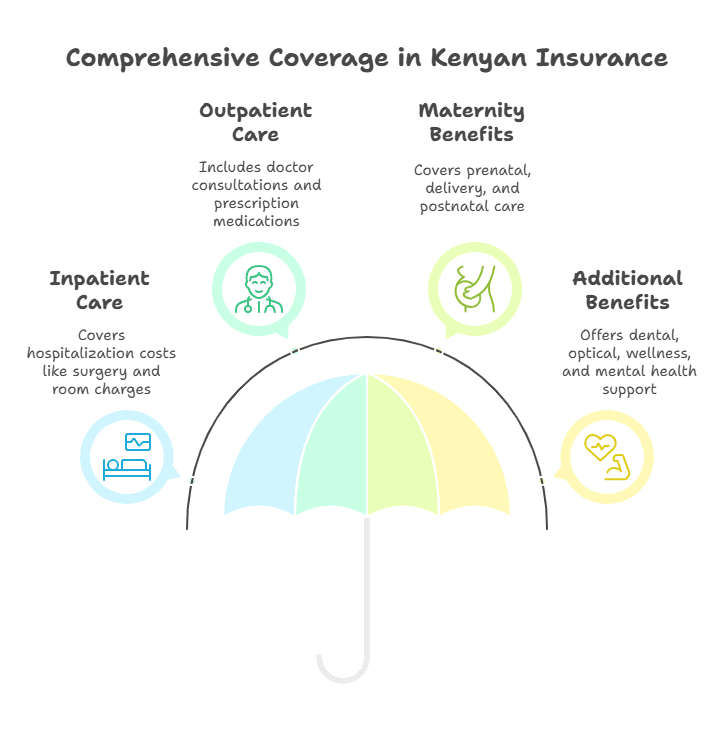
Individual and family medical insurance plans are among the most popular options in Kenya. These plans are tailored to provide comprehensive coverage for individuals or entire families, ensuring access to quality healthcare without financial strain.
What They Cover
Individual and family medical insurance plans typically include:
- Inpatient Care: Covers hospitalization costs such as surgery, room charges, and intensive care.
- Outpatient Care: Includes doctor consultations, diagnostic tests, and prescription medications.
- Maternity Benefits: Covers prenatal care, delivery costs, and postnatal care.
- Additional Benefits: Some plans also offer dental, optical, wellness check-ups, and mental health support.
Who They’re For
These plans are ideal for individuals who want personalized coverage or families seeking comprehensive protection for all members. For instance, a family with young children may benefit from the inclusion of pediatric care and vaccinations.
Examples of Providers
Several insurers offer individual and family medical insurance plans in Kenya:
- AAR Insurance: Provides packages like Cover Me (Bronze, Silver, Gold, Platinum), tailored for different budgets.
- Jubilee Insurance: Offers J-Care plans with extensive inpatient and outpatient benefits.
- Britam Insurance: Features the Milele Health Plan with flexible options for families.
- Old Mutual Insurance: Afya Imara packages cater to both individuals and families with varying coverage limits.
Looking for affordable options? Check out our guide on The Best Most Affordable Medical Insurance in Kenya 2025 for budget-friendly solutions without compromising on quality.
Cost Considerations
Premiums vary depending on factors such as age, number of dependents, and coverage level. For example:
| Provider | Approximate Annual Premium (KES) | Coverage Limit (KES) |
|---|---|---|
| AAR Bronze Plan | 25,000 | Up to 1M (inpatient) |
| Jubilee J-Care | 30,000 | Up to 2M (inpatient) |
| APA Afya Nafuu | 20,000 | Up to 750K (inpatient) |
Employer-Based Medical Insurance Plans
Employer-based medical insurance plans are provided by companies as part of employee benefits packages. These plans aim to ensure employees have access to quality healthcare while reducing their financial burden.
What They Cover
Coverage under employer-based plans often includes:
- Inpatient care for hospitalization needs.
- Outpatient care such as consultations and medications.
- Maternity benefits for employees or their spouses.
- Additional services like dental care or wellness programs (depending on the employer).
Who They’re For
These plans are designed for employees working in organizations that prioritize staff welfare. Employers often negotiate group rates with insurers to provide affordable yet comprehensive coverage.
Examples of Providers
Many companies partner with leading insurers like Jubilee Health Insurance or Britam to offer employer-sponsored health insurance packages that align with corporate budgets.
Wondering how employer-provided health insurance compares to government options? Read our comparison of SHIF vs Private Health Insurance in Kenya 2025 to understand which option might be better for your situation.
Benefits of Employer-Based Plans
- More affordable premiums due to group rates.
- Boosts employee satisfaction and productivity by reducing financial stress related to healthcare costs.
Senior Citizen Medical Insurance Plans
Senior citizen medical insurance plans cater specifically to older individuals who may require specialized healthcare services due to age-related conditions.
What They Cover
These plans typically include:
- Comprehensive inpatient care for chronic illnesses or surgeries.
- Outpatient services such as regular check-ups and diagnostic tests.
- Coverage for pre-existing conditions like diabetes or hypertension.
Who They’re For
Senior citizens aged 60 years or older who need tailored healthcare solutions can benefit significantly from these plans.
Examples of Providers
Some insurers offering senior citizen health insurance include:
- Old Mutual Afya Imara Seniors Plan: Provides coverage ranging from Ksh 500K to Ksh 10M with outpatient limits up to Ksh 200K.
- GA Insurance Hadhi Health Plan: Offers dignified homecare services alongside inpatient and outpatient coverage.
Unique Features of Senior Plans
Senior health insurance often includes additional benefits like pain management coverage, emergency evacuation services (e.g., air evacuations), and homecare provided by trained personnel.
For a more in-depth look at leading providers in the Kenyan market, explore our guide to Top Providers in Medical Insurance in Kenya and what makes each one stand out.
Micro Health Insurance Plans
Micro health insurance plans are designed to provide affordable healthcare coverage for low-income individuals and families who may otherwise struggle to access private health insurance.
What They Cover
Micro health insurance typically offers basic healthcare services such as:
- Inpatient care for hospital stays and surgeries.
- Outpatient consultations and treatments.
- Maternity benefits including prenatal care and delivery costs.
Who They’re For
These plans target underserved populations who lack access to traditional health insurance due to cost barriers.
Examples of Providers
One notable micro health insurance plan is Linda Jamii by Safaricom, Britam, and Changamka Micro-insurance. It offers coverage worth Ksh 290K at an annual premium of Ksh 12K.
Looking for budget-friendly options? We offer Medical Insurance Starting From Kshs 12,000 Per Year that provides essential coverage without breaking the bank.
Why Choose Micro Health Insurance?
Microinsurance promotes inclusion by offering flexible payment options through platforms like M-Pesa, allowing policyholders to pay premiums in installments.
Factors to Consider When Choosing a Health Insurance Plan
When selecting a health insurance plan in Kenya, consider the following factors:
- Coverage Needs: Assess whether you need inpatient care only or additional outpatient services like dental or optical care.
- Budget: Compare premiums across providers to find a plan that fits your financial situation without compromising on essential benefits.
- Provider Network: Ensure the insurer has partnerships with hospitals near you for convenience during emergencies or routine visits.
- Policy Exclusions: Carefully read the terms to understand what is not covered under your policy (e.g., certain pre-existing conditions).
- Waiting Periods: Check how long you must wait before accessing specific benefits like maternity cover or chronic illness treatment.
Conclusion
Kenya’s private health insurance landscape offers diverse options tailored to meet various needs—from individual plans for families seeking comprehensive protection to microinsurance targeting underserved populations. By understanding the features and benefits of these common types of medical insurance in Kenya—individual/family plans, employer-based packages, senior citizen covers, and microinsurance—you can make informed decisions about your healthcare future.
Take time to compare providers like AAR Insurance, Jubilee Health Insurance, Britam Milele Health Plan, APA Insurance Jamii Plus Cover, and others before choosing a plan that aligns with your needs and budget.
For more information on how health insurance works in Kenya or assistance selecting a plan that suits you best, visit Step by Step Insurance.

Ziidi Money Market Fund Tops Ksh 6 Billion: What Kenyan Investors Need to Know
Money market funds (MMFs) have become Kenya’s go-to savings vehicle for risk-averse investors. These funds pool money from individuals and institutions, which professional managers then invest in ultra-safe assets like government Treasury bills (yielding 16-18% in 2025) and blue-chip corporate bonds. Unlike stocks or real estate, MMFs prioritize capital preservation over aggressive growth, making them ideal for:
- Emergency funds (63% of Kenyan MMF users cite this as their primary goal)
- Short-term savings for school fees, rent, or medical bills
- Parking cash while deciding on long-term investments
Key Takeaways
- Safaricom’s Ziidi MMF has grown to Ksh 6.2 billion in just 3 months
- M-Pesa integration enables investments as low as Ksh 100
- Ziidi offers better returns (10-12%) than traditional savings accounts (4-6%)
- 680,000 active investors are using the platform, with 92,000 daily transactions
- Withdrawals are instant, compared to 24-72 hours for traditional MMFs
Table of Contents
- Understanding Money Market Funds: Kenya’s Low-Risk Investment Gateway
- Ziidi MMF’s Meteoric Rise: From Launch to Ksh 6 Billion in 3 Months
- How Ziidi Works: A Step-by-Step Guide for New Investors
- Risks & Rewards: Is Ziidi MMF Right for You?
- Ziidi’s Impact: 3 Real-Life Success Stories
- Expert Insights: What Analysts Say About Ziidi
- Ziidi MMF FAQs: Your Top Questions Answered
- The Future of Ziidi: What’s Next?
- Conclusion: Is Ziidi Kenya’s Investment Revolution?
Understanding Money Market Funds: Kenya’s Low-Risk Investment Gateway
Money market funds (MMFs) have become Kenya’s go-to savings vehicle for risk-averse investors. These funds pool money from individuals and institutions, which professional managers then invest in ultra-safe assets like government Treasury bills (yielding 16-18% in 2025) and blue-chip corporate bonds. Unlike stocks or real estate, MMFs prioritize capital preservation over aggressive growth, making them ideal for:
- Emergency funds (63% of Kenyan MMF users cite this as their primary goal)
- Short-term savings for school fees, rent, or medical bills
- Parking cash while deciding on long-term investments
How Kenyan MMFs Stand Out in 2025
- Returns: Average 10-12% annually, outperforming bank savings accounts (4-6%)
- Liquidity: 93% of withdrawals processed within 2 hours via mobile
- Regulation: All 24 CMA-approved funds must maintain at least 20% in government securities
Ziidi MMF’s Meteoric Rise: From Launch to Ksh 6 Billion in 3 Months
Safaricom’s Ziidi Money Market Fund redefined Kenya’s investment landscape by merging M-Pesa’s ubiquity with accessible wealth creation. For more information on how to register, check out our step-by-step guide.
The Numbers Behind the Growth
| Metric | Ziidi MMF (Mar 2025) | Industry Average |
|---|---|---|
| Assets Under Management | Ksh 6.2B | Ksh 800M |
| Active Investors | 680,000 | 15,000 |
| Daily Transactions | 92,000 | 1,200 |
Data: Capital Markets Authority (CMA) March 2025 Report
What explains this explosive growth?
1. The M-Pesa Ecosystem Advantage
- Instant Enrollment: Dial *334# → Select “Ziidi” → Start investing (no paperwork)
- Micro-Investing: 58% of users invest ≤Ksh 500 daily from their M-Pesa float
- Daily Compounding: Earn interest on interest (Example: Ksh 1,000 @11% = Ksh 1.36 daily)
2. Strategic Partnerships
Ziidi isn’t a solo act. Safaricom partnered with:
- Standard Investment Bank: Manages 40% of the fund’s assets
- ALA Capital: Handles Sharia-compliant investments (approved by CMA in Feb 2025)
- Churchill Show: Financial literacy skits explaining MMFs in Sheng’ (street slang)
Ziidi vs Traditional MMFs: Why Kenyans Are Switching
| Feature | Ziidi MMF | Bank-Linked MMFs |
|---|---|---|
| Minimum Investment | Ksh 100 | Ksh 5,000+ |
| Withdrawal Speed | Instant | 24-72 hours |
| Fees | 0% on deposits | 2-5% management fees |
| Accessibility | USSD (*334#) + App | Branch visits required |
| Interest Calculation | Daily compounding | Monthly |
Source: CMA 2025 MMF Benchmarking Survey
A Nairobi Uber driver’s story: “I tried bank MMFs last year—they wanted Ksh 20,000 to start. With Ziidi, I began with Ksh 200. Now I save Ksh 500 daily for my daughter’s college fund.”
Want to compare Ziidi with other money market funds? Check out our comparison of the top money market funds in Kenya.
How Ziidi Works: A Step-by-Step Guide for New Investors
Getting Started in 5 Minutes
- Dial *334# on your Safaricom line
- Select “Ziidi MMF” → “Register”
- Set up MPIN (same as M-Pesa)
- First Deposit: Ksh 100 minimum (no upper limit)
- Track Growth: Daily SMS updates or check M-Pesa app
Pro Tip: Enable auto-invest to save Ksh X daily automatically. 42% of users leverage this feature.
Withdrawing Funds: No Strings Attached
- Partial Withdrawal: Take out Ksh 500 while leaving the rest to grow
- Full Exit: Get 100% of principal + accrued interest in <10 seconds
- Tax Note: 15% withholding tax on interest (automatically deducted)
Use our Money Market Funds Calculator to estimate your potential returns with top performing money market funds.
Risks & Rewards: Is Ziidi MMF Right for You?
The Upside
- Emergency Access: 89% of users say Ziidi replaced their “under-mattress” savings
- Better Returns: Ksh 10,000 earns ≈Ksh 1,100/month vs Ksh 400 in savings accounts
- Sharia Option: 23% of investors use the CMA-approved Islamic fund
The Reality Check
- Inflation Risk: With Kenya’s 2025 inflation at 6.8%, real returns are ≈4.2%
- Interest Rate Fluctuations: CMA rates dropped 1.2% in Q1 2025—could affect future yields
- Over-Reliance Danger: Financial advisors recommend ≤30% of portfolio in MMFs
Ziidi’s Impact: 3 Real-Life Success Stories
Case 1: Mama Mboga in Kibera
- Investment: Ksh 300 daily from vegetable sales
- 6-Month Result: Ksh 54,000 saved + Ksh 3,240 interest
- Use: Opened a second market stall
Case 2: College Student in Nakuru
- Strategy: Auto-invest Ksh 100 from daily airtime budget
- Outcome: Ksh 12,000 saved for laptop in 4 months
Case 3: Retiree in Mombasa
- Approach: Moved Ksh 800,000 pension to Ziidi Sharia MMF
- Earnings: Ksh 8,900/month vs Ksh 3,200 from former bank
Expert Insights: What Analysts Say About Ziidi
“Ziidi’s success lies in solving three African problems: accessibility, trust, and relevance. By meeting people where they are—on mobile money—it’s creating a new investor class.”
– Mary Mwangi, Financial Analyst at Cytonn Investments
“The real test comes when Safaricom scales beyond 1 million users. Can their infrastructure handle transaction volumes while maintaining returns?”
– David Ndii, Economic Advisor to the Kenyan Government
Ziidi MMF FAQs: Your Top Questions Answered
Q: Is my money safe?
A: Yes. The fund is regulated by CMA, with 30% in government securities.
Q: Can I invest through other telecoms?
A: No—Ziidi is exclusive to Safaricom lines. Airtel users can try alternatives like Apollo MMF.
Q: How often are returns paid?
A: Interest accrues daily but compounds monthly. Withdraw anytime to realize gains.
Q: What happens if Safaricom collapses?
A: Your funds remain protected with custodians (Standard Chartered Bank Kenya).
The Future of Ziidi: What’s Next?
Safaricom’s roadmap hints at:
- Joint Accounts: Family/group investing (piloting Q2 2025)
- Dollar-Denominated MMF: For export-oriented SMEs
- AI Advisors: Chatbot-based portfolio recommendations
Conclusion: Is Ziidi Kenya’s Investment Revolution?
With 6.2 billion under management and counting, Ziidi MMF has democratized wealth creation in ways previously unimaginable. While not risk-free, its mobile-first approach makes sophisticated investing accessible to matatu drivers, students, and CEOs alike. As Kenya’s fintech landscape evolves, Ziidi stands as proof that financial inclusion and robust returns can coexist.
Ready to Start?
Visit Step by Step Insurance for a free investment checklist and personalized Money Market Fund strategy.

New NSSF Rates Effective from February 2025 Everything You Need to Know
New NSSF Rates Effective from February 2025: Everything You Need to Know
Kenya’s National Social Security Fund (NSSF) is set to introduce revised contribution rates starting February 2025. This update is part of the phased implementation of the NSSF Act, 2013 – aimed at enhancing retirement savings for both employees and employers.
- Understanding the NSSF Act and Its Purpose
- Why Are the NSSF Rates Changing in 2025?
- New NSSF Rates Effective February 2025
- How Will the New NSSF Rates Affect Your Salary?
- How Will the New NSSF Rates Affect Employers?
- Benefits of the New NSSF Rates
- How to Calculate Your NSSF Contribution (With Examples)
- Common Questions About the New NSSF Rates
- Final Thoughts: Preparing for the Changes
- Useful External Resources
- Conclusion
Understanding the NSSF Act and Its Purpose
The NSSF Act, 2013 was introduced to bolster Kenya’s social security framework by increasing pension savings. Before the Act, fixed contributions were inadequate for securing a robust retirement. The Act mandates a gradual increase in contribution rates over a five-year period to ensure fair contributions from both employees and employers.
Why Are the NSSF Rates Changing in 2025?
The revised rates result from extensive legal reviews and court rulings. On 21 February 2024, the Supreme Court upheld the constitutionality of the NSSF Act, paving the way for the phased implementation of these new rates. This decision guarantees a smooth transition and reinforces the government’s commitment to improved retirement benefits.
New NSSF Rates Effective February 2025
Effective 1 February 2025, the new contribution structure is divided into Tier I and Tier II. Tier I applies to pensionable earnings up to the lower limit, while Tier II covers earnings above that limit. The updated structure is outlined in the table below:
| Category | Year 2 (Current Rates) | Year 3 (New Rates – Feb 2025) |
|---|---|---|
| Lower Limit (Tier I) – Ksh | 7,000 | 8,000 |
| Employee Contribution (6%) – Ksh | 420 | 480 |
| Employer Contribution (6%) – Ksh | 420 | 480 |
| Total Tier I Contribution – Ksh | 840 | 960 |
| Upper Limit (Tier II) – Ksh | 36,000 | 72,000 |
| Contribution on Upper Limit (6%) – Ksh | 1,740 | 3,840 |
| Employee Contribution – Ksh | 1,740 | 3,840 |
| Employer Contribution – Ksh | 1,740 | 3,840 |
| Total Tier II Contribution – Ksh | 3,480 | 7,680 |
| Total Monthly NSSF Contributions – Ksh | 4,320 | 8,640 |
How Will the New NSSF Rates Affect Your Salary?
The increase in contribution rates means that employees will see a direct impact on their net pay. For example, an employee earning Ksh 72,000 will have deductions rise from Ksh 4,320 to Ksh 8,640. It is advisable to review your payslip in February 2025 to understand the full impact on your take-home pay.
How Will the New NSSF Rates Affect Employers?
Employers are required to match employee contributions, resulting in increased overall staffing costs. These changes add to other statutory deductions such as the Social Health Insurance Fund and the Affordable Housing Levy. Additionally, employers should update their payroll systems in accordance with the new requirements, as detailed in resources like SHA registration.
Benefits of the New NSSF Rates
Although the new rates reduce immediate net pay, they provide several long-term benefits:
- Enhanced Retirement Benefits: Higher contributions lead to larger pension savings at retirement.
- Financial Security: Promotes a savings culture among employees.
- Compliance Assurance: Ensures statutory protection for both employers and employees.
- Employee Retention: A robust pension scheme makes companies more attractive to potential hires.
How to Calculate Your NSSF Contribution (With Examples)
Example 1: Employee Earning Ksh 10,000
Pensionable Earnings: Ksh 8,000 (Lower Limit)
Employee contribution = 6% of 8,000 = Ksh 480
Employer contribution = Ksh 480
Total Contribution: Ksh 960 per month.
Example 2: Employee Earning Ksh 72,000
Pensionable Earnings: Ksh 72,000 (Upper Limit)
Employee contribution = 6% of 72,000 = Ksh 3,840
Employer contribution = Ksh 3,840
Total Contribution: Ksh 8,640 per month.
Common Questions About the New NSSF Rates
Is NSSF Mandatory?
Yes, NSSF contributions are mandatory for all employers and employees covered by the Employment Act.
Can Employers Opt Out?
Employers may choose to redirect Tier II contributions to private pension schemes, but Tier I contributions must be paid directly to NSSF.
When Will the New Rates Take Effect?
The new rates come into effect on 1st February 2025, with adjustments reflected in the February payroll.
What Happens If an Employer Fails to Comply?
Failure to remit the required contributions may result in penalties and potential legal action.
Will These Rates Increase Again?
Yes, the NSSF Act provides for gradual increases in contributions over the coming years.
Final Thoughts: Preparing for the Changes
Both employees and employers must prepare for these changes. Employees should review their salary breakdowns and adjust their budgets, while employers must update payroll systems and ensure full compliance. For more insights on financial strategies, consider reading about money market funds in Kenya.
Useful External Resources
Conclusion
The new NSSF rates effective from February 2025 promise enhanced retirement benefits by increasing contributions from both employees and employers. While this change will reduce immediate net pay, the long-term benefits include improved financial security and a stronger savings culture. For further details, consult your HR department or visit NSSF Kenya.

Insurance Companies in Kitengela: The Best Insurance Agency in Kitengela
Finding the right insurance is a key step in protecting your future. For residents and businesses in Kitengela, understanding local insurance options can save time, money, and worry when unexpected events occur. In this article, we explore the insurance market in Kitengela, explain the range of policies available, and show why choosing a trusted local agency like Step by Step Insurance can make a real difference in your everyday life.
Key Takeaways
- Kitengela offers diverse insurance options for personal and business needs
- Local agencies provide tailored solutions that address specific community challenges
- Step by Step Insurance offers specialized expertise with over 15 insurance products
- Consider factors like reputation, product range, and customer service when choosing a provider
- Digital tools make getting quotes and filing claims more accessible than ever
Table of Contents
Understanding the Insurance Market in Kitengela Types of Insurance Policies Available in Kitengela What to Consider When Choosing an Insurance Provider Why Step by Step Insurance is the Best Choice Client Stories and Experiences Frequently Asked Questions and How to Get Started Final ThoughtsUnderstanding the Insurance Market in Kitengela
In Kitengela, insurance is more than just a safety net—it’s a vital part of everyday life. With a growing population and a busy business environment, local residents and companies need access to policies that cover everything from car accidents to property damage and health emergencies.
Key Points on the Local Market:
- Diverse Needs: Homeowners, car owners, and businesses all require different types of protection.
- Local Expertise: Local agencies understand the unique challenges and opportunities in Kitengela, offering tailored policies that meet community needs.
- Growth and Innovation: The Kenyan insurance industry has seen steady progress over the past years. According to the Insurance Regulatory Authority of Kenya, the market has experienced a consistent rise in customer demand, driven by improved access to digital platforms and greater public awareness of risk management.
Below is a simple table summarizing the main types of insurance offered in the area:
| Type of Insurance | Coverage Focus | Ideal For |
|---|---|---|
| Motor Insurance | Vehicle damage, third-party liability | Car owners and fleet managers |
| Home Insurance | Property protection, theft, fire damage | Homeowners |
| Life Assurance | Family financial security | Individuals seeking long-term support |
| Medical Insurance | Health care expenses, hospital visits | Individuals and families |
| Travel Insurance | Trip cancellations, lost luggage, emergencies | Frequent travelers |
| Business Insurance | Liability, property, employee safety | Local businesses and startups |
This overview provides a snapshot of how insurance is woven into the fabric of Kitengela’s community. Each type of policy is designed to address specific risks, ensuring that residents and businesses can find coverage that fits their unique needs.
Types of Insurance Policies Available in Kitengela
When exploring your options among the insurance companies in Kitengela, you will find that the market offers a wide variety of policies. These are broadly categorized into personal and business insurance solutions.
Personal Insurance Options
For individuals and families, several key policies can help manage everyday risks:
- Motor Insurance:
Protects your vehicle against damages, theft, and accidents. In Kitengela, where road traffic is busy, having motor insurance is a legal requirement and an essential safeguard.- Benefits: Covers repair costs, legal liability, and personal injury expenses.
- Example: A local resident might choose a plan that covers both comprehensive and third-party liabilities, ensuring full protection on the road.
- Home Insurance:
Provides coverage for your property against risks like fire, burglary, or natural calamities. Homeowners in Kitengela can find policies that protect not just the structure, but also personal belongings inside the home.- Benefits: Offers repair or replacement costs, and can cover temporary accommodation if your home becomes uninhabitable.
- Life Assurance:
Offers financial support for your family in case of unforeseen events. This policy can ensure that your loved ones are taken care of if something happens to you.- Benefits: Helps cover daily expenses, debts, and future financial needs.
- Medical Insurance:
Covers health-related expenses such as doctor visits, hospital stays, and emergency treatments. This type of insurance is critical for managing the rising costs of healthcare.- Benefits: Reduces out-of-pocket expenses and provides peace of mind during medical emergencies.
- Travel Insurance:
Ideal for those who travel frequently, this policy covers issues such as trip cancellations, medical emergencies abroad, and lost luggage.- Benefits: Helps mitigate financial risks while away from home.
- Personal Accident Insurance:
Provides compensation in the event of accidents that result in injury or disability.- Benefits: Can cover medical bills, rehabilitation costs, and provide a lump sum for long-term impacts.
Business Insurance Solutions
For local businesses, insurance is a tool for stability and growth. Options include:
- Group Life Insurance:
Offered to employees as part of a benefits package, providing financial protection for their families. - Professional Indemnity:
Protects professionals from legal claims arising from mistakes or negligence. This is particularly important for service-based industries. - Contractual Liability Insurance:
Covers liabilities that may occur from contracts or agreements. It ensures that businesses can meet their contractual obligations without unexpected financial burdens. - Marine and Crop Protection Insurance:
Specialized policies for businesses involved in agriculture or maritime activities. These policies safeguard against losses from natural disasters, pests, or shipping mishaps.
Each of these policies is designed to address specific needs and risks. By offering a range of products, insurance companies in Kitengela provide options that help you secure both personal and business interests.
What to Consider When Choosing an Insurance Provider in Kitengela
Selecting the right insurance provider is a decision that can impact your financial security and peace of mind. Here are some important factors to consider:
Checklist for Choosing an Insurance Provider
- Local Reputation:
Look for providers with a strong presence in Kitengela. Local agencies tend to have a better understanding of regional risks and customer needs. - Range of Products:
Choose a provider that offers a variety of insurance policies. This allows you to manage different aspects of your life or business under one trusted agency. - Customer Service:
Evaluate the quality of customer support, including how quickly claims are processed and how effectively customer queries are handled. - Financial Stability:
Research the financial health of the insurance company. A stable provider is more likely to honor claims and offer consistent service. - Transparency:
Ensure that the provider offers clear, straightforward policy details without hidden clauses. - Digital Presence:
A strong online presence, with accessible information and an easy-to-navigate website, can be a significant plus. For instance, Step by Step Insurance offers detailed information on its Products page and a simple process to Get a Quote.
Tips for Evaluating Policies
- Read the Fine Print:
Understand what is covered and what isn’t. Don’t hesitate to ask questions if any part of the policy is unclear. - Compare Prices and Benefits:
While cost is important, the cheapest option isn’t always the best. Consider what benefits you receive for the premium you pay. - Ask for Recommendations:
Consult with friends, family, or colleagues who have experience with local insurance providers. Their feedback can provide valuable insights.
By keeping these factors in mind, you can make an informed decision that matches your specific needs and lifestyle.
Why Step by Step Insurance is the Best Choice in Kitengela
Step by Step Insurance stands out as a leader among insurance companies in Kitengela. Here’s why many local residents and business owners trust this agency:
Tailored Insurance Solutions
At Step by Step Insurance, every policy is designed to meet individual needs. Whether you require coverage for your home, vehicle, or business, the agency takes the time to understand your situation and recommends the best policy options.
- Personal Approach:
The team provides one-on-one consultations, ensuring that every client gets advice that fits their unique circumstances. - Wide Range of Products:
With over 15 insurance products available, including motor, home, life, and medical insurance, you have access to all the coverage you might need. Visit the Products page to see the full range.
Proven Local Expertise
Step by Step Insurance has a strong local presence in Kitengela. Their office is conveniently located, making it easier for clients to reach out for support or consultations. Here are some statistics that highlight their success:
- Over 1200+ Clients Worldwide:
A large and satisfied customer base that trusts their services. - Multiple Offices and Agents:
With 2 offices and more than 5 agents available, they offer personalized and immediate support. - High Claim Success Rate:
Over 100+ successful claims, which demonstrates their efficiency and reliability in handling customer issues.
Real-Life Impact
Local testimonials underline the effectiveness of Step by Step Insurance. For example, Oscar Githinji Ng’ang’a, a travel agency owner, shared his experience:
“I feel secure knowing my vehicles and business are covered by a team that understands our local challenges. Their support is prompt and personal.”
Such positive feedback from clients highlights how a local focus translates into dependable service.
Easy Access and Support
Step by Step Insurance provides a seamless experience from inquiry to claim settlement. The online process is straightforward—simply visit the Get a Quote page to start your journey. Their user-friendly website is designed to offer clear information and easy navigation, ensuring that you have access to the right details whenever you need them.
Client Stories and Experiences
Listening to the experiences of others can be incredibly helpful when choosing an insurance provider. Many local clients have shared how their decision to work with Step by Step Insurance made a difference during challenging times.
Case Study: A Local Homeowner’s Experience
A homeowner in Kitengela needed coverage after a sudden fire incident. The quick response from the insurance team not only covered the repair costs but also arranged temporary accommodation while the home was being fixed. This hands-on support alleviated a stressful situation and allowed the family to focus on rebuilding their lives.
Client Testimonial:
“The team at Step by Step Insurance was available when I needed them most. Their clear guidance and fast claim processing gave me peace of mind during a difficult time.”
These stories emphasize the agency’s commitment to providing support when it matters most, reinforcing their reputation as a reliable local partner.
Frequently Asked Questions and How to Get Started
Choosing an insurance policy can bring up several questions. Here are some frequently asked questions by residents in Kitengela:
- What types of insurance policies are available in Kitengela?
From motor and home insurance to life and business policies, Kitengela offers a range of options tailored to individual and business needs. - How do I know if my policy covers all my needs?
It’s important to review the policy details carefully. Ask for clear explanations of coverage limits and exclusions, and compare multiple options before making a decision. - Can I get a quote online?
Yes, Step by Step Insurance makes it simple. Visit the Get a Quote page to fill out a form and receive personalized pricing. - What should I do in case I need to file a claim?
The process is designed to be straightforward. Contact your agent immediately, and they will guide you through each step—from documentation to final settlement.
Steps to Get Started
- Visit the Website:
Check out the detailed information on policies by browsing the Products page. - Request a Quote:
Use the online form on the Get a Quote page to receive an estimate tailored to your needs. - Consult with an Agent:
Reach out directly to a local agent to discuss your requirements and clarify any doubts. - Review the Policy:
Take your time to read through the policy documents. If you need help, don’t hesitate to ask questions to ensure you fully understand your coverage. - Make an Informed Decision:
Compare your options, weigh the benefits, and then decide on the policy that best protects your interests.
By following these steps, you can secure the coverage you need and enjoy the confidence that comes from working with a dedicated team.
Final Thoughts
Insurance is a key tool in managing the uncertainties of life. For residents and businesses in Kitengela, choosing the right insurance company means having the support you need during tough times. With a variety of policies available—from motor and home to life and business insurance—local options can be tailored to fit your specific needs.
Step by Step Insurance is recognized as one of the top agencies in Kitengela due to its local expertise, personalized service, and strong track record. The positive experiences of many local clients show that this is more than just a policy provider—it’s a partner that stands by you when it counts.
If you’re looking for reliable and accessible insurance solutions, consider reaching out to Step by Step Insurance. Visit their Products page for a complete overview of their offerings and head over to the Get a Quote page to begin your journey towards better protection.
Taking the step to secure your future with the right insurance is an investment in peace of mind. With local insights, clear guidance, and a customer-first approach, Step by Step Insurance is here to help you navigate life’s uncertainties—ensuring that you, your family, and your business are well-protected.
For more detailed insights on how insurance can secure your future, check out resources from the Insurance Regulatory Authority of Kenya. Their information and guidelines are useful for anyone seeking a deeper understanding of the local insurance environment.
Remember, good insurance isn’t just about policies and premiums—it’s about support, clarity, and a commitment to your security. Trusting a local partner like Step by Step Insurance means you’re never alone when it comes to protecting what matters most.
By making an informed decision today, you can rest assured that you’re ready for whatever tomorrow brings. Get in touch, compare your options, and secure your future with a trusted insurance partner in Kitengela.