5 Common WIBA Insurance Mistakes Kenyan Employers Make | Step by Step Insurance
In Kenya, the Work Injury Benefits Act (WIBA) of 2007 requires every employer to provide compensation to employees who suffer injuries, diseases, or even death while in the course of their employment. To comply with this law and protect workers, employers are expected to take out WIBA Insurance.
However, many companies either treat WIBA cover as just a box-ticking exercise or fail to understand what it really covers — leaving themselves exposed to legal penalties and hefty financial losses when accidents happen.
Here are the 5 most common mistakes Kenyan employers make with WIBA Insurance — and how to avoid them.
🎯Key Takeaways
WIBA insurance is a legal requirement under Kenyan law, not optional
Accurate employee reporting is crucial for proper claims settlement
WIBA covers more than just workplace accidents – including occupational diseases
Prompt reporting of incidents is essential to avoid claim invalidation
WIBA should be complemented with additional coverage for comprehensive protection
Connect with fellow business owners and stay updated on the latest insurance trends, WIBA updates, and compliance tips. Get expert advice and share experiences with our community of insurance-conscious employers.
Understand the real financial impact of not having WIBA insurance
❌1. Failing to Take WIBA Insurance Altogether
Believe it or not, some employers in Kenya still operate without WIBA insurance. They assume that because accidents are rare in their sector, the cover isn’t necessary. Others confuse it with Group Personal Accident (GPA) insurance, assuming the two are interchangeable.
Why this is a mistake:
WIBA is a legal requirement under Kenyan law. Failure to provide it can lead to fines, lawsuits, or even closure of your business.
GPA is optional and offers different benefits. Only WIBA ensures full compliance.
How to avoid it:
Work with a licensed intermediary like Step by Step Insurance to ensure you purchase a compliant WIBA policy that matches your workforce needs.
❌2. Underreporting the Number of Employees or Salaries
Some employers under-declare the number of staff or report lower salaries when taking WIBA to reduce premiums.
Why this is a mistake:
Compensation under WIBA is based on an employee’s salary. If you under-declare, your employees (or their families) could receive less compensation than they deserve.
Worse, insurers may reject claims if they find inconsistencies in declarations.
How to avoid it:
Always provide accurate employee records, including updated payroll details. This ensures claims are settled fairly and quickly.
❌3. Not Understanding What WIBA Actually Covers
Many employers believe WIBA only covers injuries that occur in the workplace. The truth is broader.
Occupational diseases (caused by exposure at work)
Death while on duty
Permanent or temporary disability due to work injuries
Medical expenses related to workplace accidents
Why this is a mistake:
Without understanding the scope, some employers fail to guide employees correctly — leading to confusion, mistrust, and disputes during claims.
How to avoid it:
Request a clear explanation of policy terms from your insurer or intermediary. At Step by Step Insurance, we simplify WIBA policies for HR teams and managers so you know exactly what’s covered.
❌4. Delaying or Ignoring Claims Reporting
Accidents should be reported to insurers and the Directorate of Occupational Safety and Health Services (DOSHS) promptly. Unfortunately, many employers delay claims — sometimes to “protect the company’s image.”
Why this is a mistake:
Delays can invalidate claims, leaving the employer to shoulder the financial burden.
Employees may lose trust and even sue the employer.
How to avoid it:
Establish a clear internal policy: report all work-related accidents to your insurer within 24–48 hours and file the required DOSHS reports.
❌5. Treating WIBA as a Standalone Solution
Some employers assume that once they’ve purchased WIBA, they don’t need any other cover.
Why this is a mistake:
WIBA strictly covers work-related accidents and diseases.
It does not cover accidents outside work hours (e.g., weekends, commuting, or off-duty activities).
It also doesn’t cover life-threatening illnesses unrelated to the workplace.
How to avoid it:
Pair WIBA with Group Personal Accident (GPA) or Group Life Insurance to provide well-rounded protection for employees.
🏢Why Step by Step Insurance?
Navigating WIBA requirements can be tricky. At Step by Step Insurance, we specialize in helping employers across Kenya:
Stay compliant with the Work Injury Benefits Act
Find affordable WIBA packages tailored to their workforce
Simplify claims processing and documentation
Bundle WIBA with GPA or Group Life cover for comprehensive protection
💬“Too often, employers come to us after facing penalties or disputes that could have been avoided with the right WIBA cover. Our mission is to help you get it right the first time.” — Faith Kimaru, Principal Officer, Step by Step Insurance
✨Final Word
WIBA insurance isn’t just about compliance — it’s about protecting your people and your business. Avoiding these five common mistakes ensures that your employees are taken care of and that your company avoids unnecessary financial and legal risks.
Farm Protector Insurance Kenya – Comprehensive Agricultural Coverage
Agribusiness in Kenya is rewarding, but it’s also unpredictable. One bad season, an equipment breakdown, or unexpected disaster can cause massive losses. That’s why Farm Protector Insurance exists — to safeguard your farm or agricultural business from risks that could disrupt your operations. The Geminia Farm Protector package is designed to provide comprehensive, customizable protection for every stage of the agricultural value chain — from production to processing, distribution, and even sales.
Farm Protector Insurance is a sectionalized insurance package that covers a wide range of risks in agriculture, from crops and livestock to buildings, machinery, employees, and even your income. Instead of buying multiple separate policies, you can select the sections relevant to your business and get them all under one simplified policy.
Key Areas Covered Under Farm Protector Insurance
Farm Protector is divided into 12 main sections, each covering specific risks. You can choose the ones that apply to your farm or agribusiness.
Coverage Section
Description
Key Benefits
Agriculture Insurance
Protects biological assets such as livestock, crops, and plants — including those under contract farming, leasing, or financing agreements.
Comprehensive biological asset protection
Buildings, Structures & Equipment
Covers damage or loss to farm buildings, greenhouses, fittings, and fixtures due to fire or other listed risks.
Property and infrastructure security
Work Injury Benefit Act (WIBA)
Provides compensation to employees injured while on the job — meeting your legal obligations.
Legal compliance and employee protection
Greenhouse Insurance
Protects the greenhouse structure and crops inside against windstorms, excessive rainfall, and fire.
Specialized greenhouse protection
Machinery Breakdown
Covers damage to essential farm and processing machinery due to sudden and unforeseen breakdowns.
Equipment continuity assurance
Burglary
Protects against theft involving forcible entry into your premises.
Security against theft
Goods in Transit
Covers goods being transported — from your farm to the market or processing facility.
Transportation risk coverage
Office Equipment
Protects your office tools and electronics from sudden loss or damage.
Administrative asset protection
Farm Motor Vehicles
Covers tractors, harvesters, farm trailers, and other agricultural vehicles.
Agricultural vehicle protection
Deterioration of Stock
Compensates for perishable goods (like fish, milk, or produce) that spoil due to cold storage equipment failure.
Perishable goods security
Loss of Profit
Covers lost income if production stops due to the loss of crops or livestock.
Income protection guarantee
Credit Life
Ensures debt repayments are covered if a borrower in your agribusiness passes away.
Debt protection for families
Extra Cover Options
You can also add these additional protections to enhance your coverage:
Fire Consequential Loss
Political Violence & Terrorism
Public Liability
Fidelity Guarantee
All Risks Cover
Money Insurance
Directors & Officers Liability
Who Can Apply?
This comprehensive coverage is ideal for various agricultural stakeholders:
🌱 Small to Large-Scale Farmers
Whether you’re growing maize, vegetables, or managing livestock, protect your livelihood with customized coverage options.
🏢 Agribusiness Companies
Comprehensive protection for commercial agricultural operations from seed to market.
🚛 Produce Distributors
Secure your goods in transit and protect your distribution infrastructure.
🏭 Food Processors
Cover your processing equipment, facilities, and finished products against unexpected losses.
🏪 Agri-Retailers
Protect your inventory, premises, and business operations in the agricultural retail sector.
Why Choose Farm Protector Insurance?
Customizable Coverage – Pick only the sections relevant to your needs
Comprehensive Protection – Covers everything from farm production to consumer sales
Simplified Policy – One policy for multiple risks, easy to manage
End-to-End Safety Net – Protects every stage of the agricultural value chain
For farmers looking to understand more about specialized agricultural coverage, you can also explore our comprehensive guide on crop insurance in Kenya, which provides detailed insights into current trends and solutions.
How Claims Are Settled
Claims are processed efficiently and paid based on the following criteria:
🌾 Crop Damage Claims
Compensation based on verified damage to insured crops due to covered perils like weather, disease, or pests.
🐄 Livestock Death Claims
Payment for death of insured livestock due to accident, disease, or other covered causes.
🏗️ Property Destruction Claims
Coverage for destruction or loss of insured buildings, equipment, and other property assets.
📋 Other Covered Claims
All other claims are settled according to the declared values specified in your individual policy terms.
Ready to Protect Your Farm? Contact Us Today!
Get personalized advice and quotes for your specific agricultural needs.
Farming is a business, and like any business, it needs protection. With the Geminia Farm Protector, you can secure your crops, animals, equipment, employees, and even your profits under one easy-to-manage policy. Don’t let unexpected risks destroy years of hard work – invest in comprehensive agricultural insurance that grows with your business.
The agricultural sector in Kenya faces numerous challenges, from unpredictable weather patterns to market volatility. Farm Protector Insurance provides the peace of mind you need to focus on what you do best – growing your agricultural business. Whether you’re a small-scale farmer or managing a large agribusiness operation, this comprehensive insurance solution adapts to your specific needs and budget.
Take the first step towards securing your agricultural future. Contact our experienced agricultural insurance specialists today to discuss how Farm Protector Insurance can be tailored to your unique farming operation. Your farm’s protection is our priority.
How to Buy Professional Indemnity Insurance in Kenya: Complete 2025 Guide
Professional indemnity insurance is no longer a luxury for professionals in Kenya — it’s a necessity. Whether you’re a doctor, lawyer, consultant, engineer, architect, accountant, or freelancer, your reputation and financial well-being are always on the line. In a world where a small professional error can lead to a costly legal claim, this cover is your safety net.
If you’re wondering how to buy professional indemnity insurance in Kenya, you’re in the right place. Here’s a simple, step-by-step guide tailored to Kenyan professionals and businesses.
🔑Key Takeaways
Essential Protection: Professional indemnity insurance protects against financial loss from client claims due to professional errors or negligence
Regulatory Requirement: Many professions in Kenya require PI insurance for licensing, tenders, and client contracts
Cost-Effective: Premiums range from KES 5,000 to KES 150,000+ annually – far less than potential claim costs
Simple Process: Getting covered involves 6 straightforward steps from risk assessment to policy purchase
Connect with fellow professionals and stay updated on the latest insurance trends, tips, and news in Kenya. Get expert advice and share experiences with like-minded individuals!
Professional indemnity insurance (also called PI or errors & omissions insurance) protects professionals from financial loss if a client suffers harm due to your advice, service, or negligence.
Professional indemnity insurance is your silent partner — protecting your work, your reputation, and your finances.
Whether you’re an individual expert or running a firm, don’t wait for a claim to realize its importance. Get covered today and keep your career protected.
🚀Ready to Get Protected?
Don’t leave your professional future to chance. Get your professional indemnity insurance quote today and secure your peace of mind.
Personal Accident Insurance for Interns in Kenya 2025 | Step by Step Insurance
As thousands of students across Kenya head into internships, one question often goes unasked: “Am I covered if something goes wrong?”
Whether you’re a university student heading for industrial attachment or a parent preparing your child for fieldwork, personal accident insurance for interns is no longer a nice-to-have — it’s a necessity.
“We’ve seen a rise in workplace incidents during attachment periods — from lab mishaps to road accidents while in transit. Having accident cover ensures students and families are financially protected when the unexpected happens.” – Faith Kimaru, Principal Officer at Step by Step Insurance
This guide breaks down everything you need to know about Personal Accident Insurance for Kenyan students during internships in 2025, and how to get affordable, reliable cover with Step by Step Insurance.
🔑Key Takeaways
Personal accident insurance is essential for students during internships
Coverage starts from as low as KES 350 for 3 months
Protection includes death, disability, medical expenses, and funeral cover
SHIF doesn’t cover accident-related disabilities or funeral expenses
Group coverage available for institutions and universities
Personal Accident Insurance provides financial compensation in the event of accidental injury, disability, or death. It’s designed to protect students during high-risk periods like industrial attachment, field training, and internships.
Unlike SHIF or general medical insurance, this cover responds specifically to accidents — whether they occur on the job, in transit, or even off-site during the internship period.
📍Why Interns in Kenya Need This Cover
Many students:
Work in environments with practical or physical risk (labs, field sites, hospitals, etc.)
Use public transport regularly
Are not covered under employer or institutional medical plans
Are exposed to risks of slips, falls, burns, cuts, or accidents
And when accidents happen, they can be both emotionally and financially devastating.
“It’s not just about protection for the student — it’s peace of mind for parents, guardians, and the institutions placing them.” – Faith Kimaru
💼What Does Personal Accident Cover Include?
At Step by Step Insurance, we’ve made it simple and accessible for students with three affordable benefit tiers:
📦Benefit Options Breakdown
Benefit
Option 1
Option 2
Option 3
Death
KES 100,000
KES 200,000
KES 300,000
Permanent Total Disability (PTD)
KES 100,000
KES 200,000
KES 300,000
Accidental Medical Expenses
KES 40,000
KES 50,000
KES 50,000
Artificial Limbs (Prosthetics)
KES 20,000
KES 30,000
KES 40,000
Last Expense (Funeral Cover)
KES 25,000
KES 50,000
KES 75,000
💰Premiums: Affordable Student-Friendly Pricing
Whether your internship lasts a few months or an entire year, we’ve got a plan for you:
Internship Period
Option 1
Option 2
Option 3
3 Months
KES 350
KES 550
KES 650
6 Months
KES 500
KES 800
KES 1,200
12 Months
KES 800
KES 1,300
KES 1,750
“We’ve structured these packages to ensure that every student — regardless of budget — can access essential protection.” – Faith Kimaru
📄How to Apply for Internship Accident Cover
Applying is quick and easy with Step by Step Insurance:
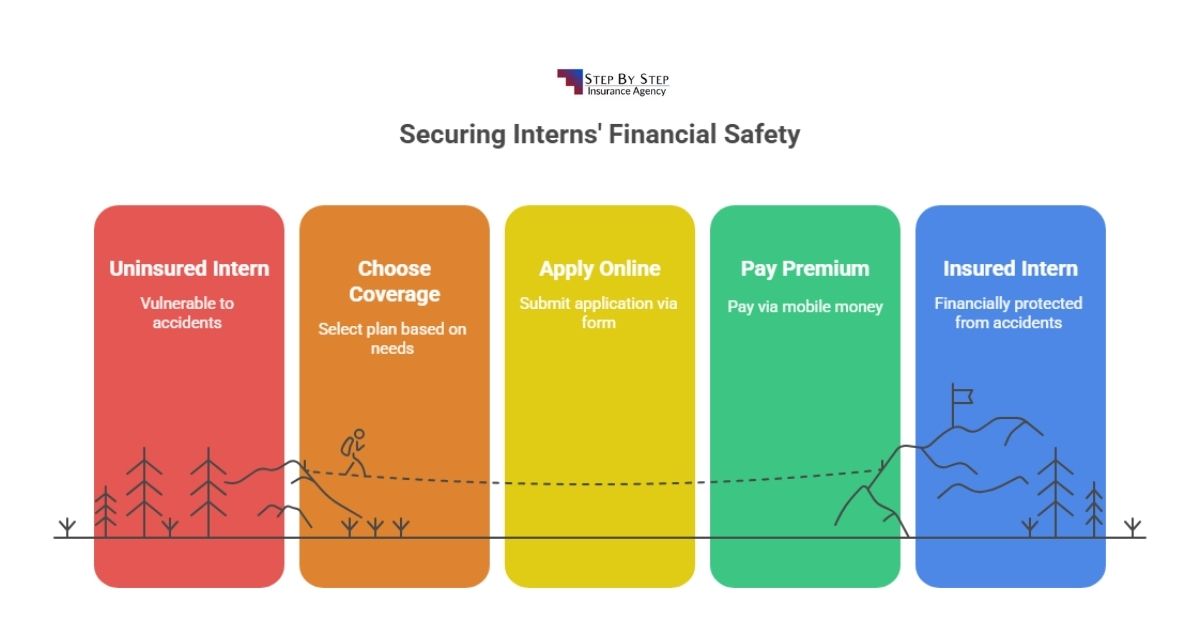
Choose your coverage option based on your internship duration and needs
Submit a quick application via our online form or office
Pay your premium via mobile money or bank
Receive your digital certificate of cover — valid for the entire internship period
✅ Institutions can also request group covers for multiple students.
🧑🏫For Universities, Colleges & Institutions
If you’re a school, TVET, or university sending students on industrial attachment:
Offer group protection at discounted rates
Boost your institution’s credibility
Ensure compliance with host company requirements
Show commitment to student welfare and safety
Step by Step Insurance works closely with academic institutions to create customized bulk plans for interns across Kenya.
If you’re thinking about life insurance in Kenya, you’re not alone. More Kenyans are realizing the importance of securing their family’s future — not just for a few years, but for life. That’s where Whole of Life Insurance comes in.
Unlike term insurance, which expires after a set period, whole of life cover guarantees a payout to your loved ones — no matter when you pass away — as long as your premiums are paid.
“It’s a lifelong promise to your family,” says Faith Kimaru, Principal Officer at Step by Step Insurance. “Whole of life insurance isn’t just protection; it’s peace of mind and legacy planning rolled into one.”
Whether you’re just starting your financial journey or you’re planning long-term wealth protection, this guide will walk you through how it works, who it’s for, and why more Kenyans are turning to whole of life cover in 2025.
Key Takeaways
Whole of life insurance provides lifelong coverage with a guaranteed payout
Premiums are fixed and never increase with age
Payouts can be used for funeral costs, debts, inheritance, and more
Some policies accumulate cash value that can be borrowed against
Ideal for long-term financial planning and legacy building
In simple terms: Whole of life insurance is a policy that lasts your entire lifetime. It pays out a guaranteed death benefit — no matter when you die — as long as the policy remains active and premiums are paid.
Unlike term insurance, which only covers you for 10, 20, or 30 years, whole of life cover never expires. That means your family will always receive a payout, which they can use for:
Funeral costs
Clearing debts
Replacing lost income
Estate taxes
Leaving an inheritance
How Whole of Life Insurance Works in Kenya
Here’s how it works step by step:
You choose the cover amount you want (e.g., Ksh 1 million or Ksh 5 million).
You pay fixed premiums monthly or annually.
The policy remains active for your entire life — no expiry.
When you pass away, your family receives the payout tax-free.
Some whole of life policies in Kenya also accumulate cash value, meaning you can:
Borrow against the policy later in life
Use it as a financial tool in retirement or emergencies
“Many of our clients use it not just for protection, but for legacy planning,” says Faith Kimaru. “It’s especially valuable for parents, professionals, and business owners.”
✅ Key Features to Expect
Feature
Why It Matters
Lifetime cover
You’re insured for life, not just a fixed term
Fixed premiums
Predictable payments that don’t increase with age
Guaranteed payout
Your family gets paid no matter when you pass on
Optional cash value
Some policies grow savings you can borrow or cash in later
Custom add-ons
You can include disability or critical illness riders
👪 Who Should Consider Whole of Life Cover?
Whole of life insurance isn’t just for the wealthy. It’s ideal for:
Young professionals building long-term financial security
Parents who want to leave a legacy for their children
Business owners planning succession or key person cover
Older adults who want funeral expenses fully covered
Anyone who wants permanent peace of mind
⚖️ Pros and Cons
✔️ Pros
Lifelong coverage
Guaranteed payout
Fixed premiums
Can support retirement or wealth transfer goals
Encourages disciplined, long-term planning
❌ Cons
Higher cost than term insurance
May not be needed if you only want short-term protection
Requires long-term commitment
“It’s not for everyone — but if you’re serious about leaving something behind, it’s one of the most powerful financial tools available,” adds Faith Kimaru.
💬 Common Questions First-Time Buyers Ask
1. How much does it cost in Kenya?
Premiums vary based on age, health, and coverage amount — but Step by Step Insurance works with you to find affordable options.
2. Can I cancel if I change my mind?
Yes, you can cancel at any time, though you may lose some benefits depending on the policy terms.
3. What happens if I miss a payment?
Most policies have a grace period. If you miss several payments, the policy may lapse — which is why regular reviews matter.
4. Can I use it as an investment?
Some whole of life plans include a cash value component, which grows over time. You can borrow against it or use it in later life.
5. Is it tax-free?
Yes. Life insurance payouts are not taxed in Kenya, making them a great wealth transfer tool.
“We don’t believe in one-size-fits-all cover,” says Faith Kimaru. “Our job is to listen, understand your needs, and recommend the best solution — not the most expensive one.”
🔚 Final Thoughts: A Lifetime of Protection Starts Now
Whole of life insurance is more than just a policy — it’s a promise to your loved ones. It ensures that no matter when life happens, your family is protected. For first-time buyers in Kenya, it offers a long-term financial solution that delivers security, stability, and significance.
📞 Ready to Take the First Step?
At Step by Step Insurance, we guide you through the process with honesty, clarity, and care.
For many Kenyan families, pets are more than just animals — they’re companions, protectors, and beloved members of the household.
But when unexpected illness, accidents, or even theft happen, veterinary care can be expensive — especially in growing urban areas like Nairobi, Kitengela, Mombasa, and Kisumu.
That’s where pet insurance comes in.
Whether you’re raising a loyal dog, an affectionate cat, or even a rabbit, pet insurance helps you protect what matters without draining your pocket. In this 2025 guide, we break down the top pet insurance options available in Kenya — starting with the most flexible and family-friendly provider.
🔑 Key Takeaways
Pet insurance in Kenya covers accidents, illness, theft, and veterinary expenses
Step by Step Insurance offers the most customizable and family-friendly options
APA Insurance provides straightforward coverage for companion animals
ICEA LION specializes in high-value dogs with comprehensive liability protection
Most policies require pets to be under 10 years old and fully vaccinated
Optional medical cover is available for treatment costs across most providers
🥇 Step by Step Insurance – Tailored Pet Cover That Puts Your Pet First
At Step by Step Insurance, we understand that no two pets — or pet owners — are alike. That’s why we work with trusted insurers to offer custom pet insurance packages built around your specific needs and budget.
Whether you’re looking to insure your family dog, your guard dog, or your cat, we help you secure protection against:
Veterinary-advised euthanasia to prevent suffering
Theft or straying
Optional: Medical cover for treatment costs
“We help you compare, quote, and choose the right cover — no guesswork. We also provide vet network support and claim assistance, so you’re never alone,” says Faith Kimaru, Principal Officer at Step by Step Insurance.
🥈 APA Insurance – Straightforward Pet Cover for Companion Animals
APA Insurance offers a clear and practical pet insurance solution for pets that are not kept for commercial gain, but rather for comfort, security, or companionship — such as dogs, cats, and rabbits.
Their basic plan covers:
Accidental death (lightning, injury, snake bite, windstorm, flood)
Illness or disease
Epidemics or widespread disease outbreaks
Vet-advised euthanasia to prevent suffering
Theft or straying
📌 Optional medical cover is available for vet treatment due to accident or illness.
APA is a solid choice for families who want basic, dependable protection — especially those with home pets or guard dogs that hold emotional and protective value.
🥉 GA Insurance – Pet Cover for the Responsible, Detail-Oriented Owner
GA Insurance provides coverage for companion animals such as dogs and cats, focusing on personal comfort pets, not livestock or income animals.
They require:
A completed application form
Proof of premium payment
Current vet medical & valuation report
Vaccination certificates
Pet photo and identification (ear tag, tattoo, microchip)
Pet must be under 10 years old
While the onboarding process is detailed, GA’s service delivery and flexibility make it a good choice for pet owners who want complete transparency and accountability in their coverage.
🐕 ICEA LION – Feature-Rich Cover for Dogs with High Value
ICEA LION offers a specialized Dog Insurance policy, divided into four distinct sections:
🔹 Section 1: Death from Accident or Illness (Mandatory)
Covers death from injury or illness, including war/terrorism-related incidents. Pets must be vaccinated, well-maintained, and between 6 months and 10 years old.
🔹 Section 2: Medical Expenses (Optional)
Reimburses veterinary treatment costs for injury or illness. Once your limit is reached, you can reinstate the policy with an additional premium.
🔹 Section 3: Theft or Straying
Pays the agreed or market value of the dog if stolen or lost and not recovered.
🔹 Section 4: Third-Party/Public Liability
Covers you if your dog injures someone or damages property. Up to Ksh 2,000,000 liability limit.
📌 Important notes:
No cover for roaming mongrels
Dogs must be valued at Ksh 20,000 or more
Premiums vary by dog value — from Ksh 7,574 to over Ksh 22,000
Dogs worth over Ksh 200,000 require a custom quote
ICEA LION is ideal for pet owners with pedigree, high-value dogs who want premium protection and liability cover.
🎥 Learn More About Pet Insurance
💡 What’s Typically Covered by Pet Insurance in Kenya?
The health insurance landscape in Kenya is rapidly evolving, and 2024 was no exception. According to the latest data from the Insurance Regulatory Authority (IRA), the health insurance sector generated a total Gross Written Premium (GWP) of Ksh 76.31 billion, with a few key players dominating the market.
Whether you’re an individual, family, or business looking to invest in reliable medical cover, understanding who the top underwriters are — and what they offer — is essential.
Here’s a breakdown of the Top 10 Health Underwriters in Kenya (2024) and expert insight from Step by Step Insurance, your trusted local agency in Hurlingham and Kitengela as well across the country.
🔍 Key Takeaways
Total health insurance market worth Ksh 76.31 billion in 2024
Top 10 insurers control 92.9% of the market
Jubilee Health leads with 18.26% market share
Old Mutual and AAR follow closely in second and third place
Total Gross Written Premium (GWP): Ksh 76.31 billion
Top 10 Insurers Control: ~92.9% of the market
Other underwriters combined: Ksh 5.42 billion (7.1% market share)
🏆 Top 10 Health Insurance Underwriters in Kenya (2024)
Rank
Insurer
GWP (Ksh Bn)
Market Share
1
Jubilee Health Insurance
13.94
18.26%
2
Old Mutual General Insurance
11.88
15.57%
3
AAR Insurance Kenya
10.77
14.12%
4
CIC General Insurance
8.00
10.49%
5
APA Insurance Limited
7.84
10.28%
6
Britam General Insurance
5.14
6.73%
7
GA Insurance Company
4.77
6.25%
8
The Heritage Insurance Company
3.38
4.42%
9
First Assurance Company
2.85
3.73%
10
Madison Insurance Company
2.33
3.05%
🔍 Key Takeaways from the 2024 Rankings
1. Jubilee Health Insurance Leads the Market
With Ksh 13.94 billion in premiums and 18.26% market share, Jubilee Health Insurance maintained its stronghold as Kenya’s No.1 health underwriter in 2024. Their wide hospital network, competitive pricing, and dependable claims processing remain major draws for employers and individuals alike.
2. Old Mutual and AAR Close Behind
Old Mutual (15.57%) and AAR (14.12%) are not far behind, proving that the top three underwriters are competing closely in pricing, customer experience, and innovation.
3. Strong Mid-Tier Competition
APA, CIC, and Britam remain trusted choices for SMEs, SACCOs, and individuals who need custom packages without the premium costs of top-tier plans. For more on APA’s offerings, see our APA Afya Nafuu Health Insurance Guide.
🗣️ Expert Insight from Step by Step Insurance
“At Step by Step Insurance, we work with many of these top underwriters — including Jubilee, Britam, Old Mutual, and AAR — to match our clients with the best-fit health insurance solutions,” says Faith Kimaru, Principle Officer at Step by Step Insurance.
“What matters most isn’t just brand name, but how well the policy fits your needs, budget, and access to care — especially in areas like Kitengela, where we help clients compare plans that work both locally and nationally.”
The Kenyan health insurance industry is growing — but choosing the right partner requires more than checking a ranking. Let trusted brokers like Step by Step Insurance help you navigate your options and secure a plan that gives you peace of mind.
Why Every DJI Owner in Kenya is Racing to Get Insured
Picture this: Your DJI Mavic 3 captures Kilimanjaro’s golden sunrise—a shot that could land a National Geographic feature. Suddenly, a wind shear slams it into a lodge balcony. Shattered glass. Guest injuries. A KES 3 million lawsuit.
This is Kenya’s drone reality in 2025. Without insurance, you pay for everything.
The Kenyan Drone Pilot’s Nightmare
🔥 KCAA Fines: Up to KES 500,000 for uninsured flights
💸 Liability Bombshells: Medical bills + property damage = millions in losses
🚫 Business Death: License revocation = grounded operations
🛑 DJI Graveyard: No hull coverage? Say goodbye to your KES 800,000 drone
“65% of drone claims in Kenya involve 3rd-party damage” – KCAA Safety Report 2023
Your DJI’s Legal Lifeline: Nationwide Coverage, Lightning-Fast Approval
KCAA-Compliant in 3 Simple Steps
1. What You GET with DJI-Specific Insurance:
Coverage Type
Protects You From
Why DJI Owners Need It
Third-Party Liability
Injury/property lawsuits
KCAA’s KES 5M minimum requirement
DJI Hull Insurance
Crashes, water damage, fires
Repair your Mavic/Phantom without cash pain
Theft Coverage
Stolen drones & equipment
Nairobi/Mombasa theft hotspots
Payload Protection
Ruined cameras & sensors
Save your Zenmuse X7 investment
2. How Fast is “Fast Approval”?
✅ Online Quote: 2 minutes (no forms)
✅ Policy Issued: As soon as same-day
✅ KCAA Compliance Certificate: Digital copy in 24hrs
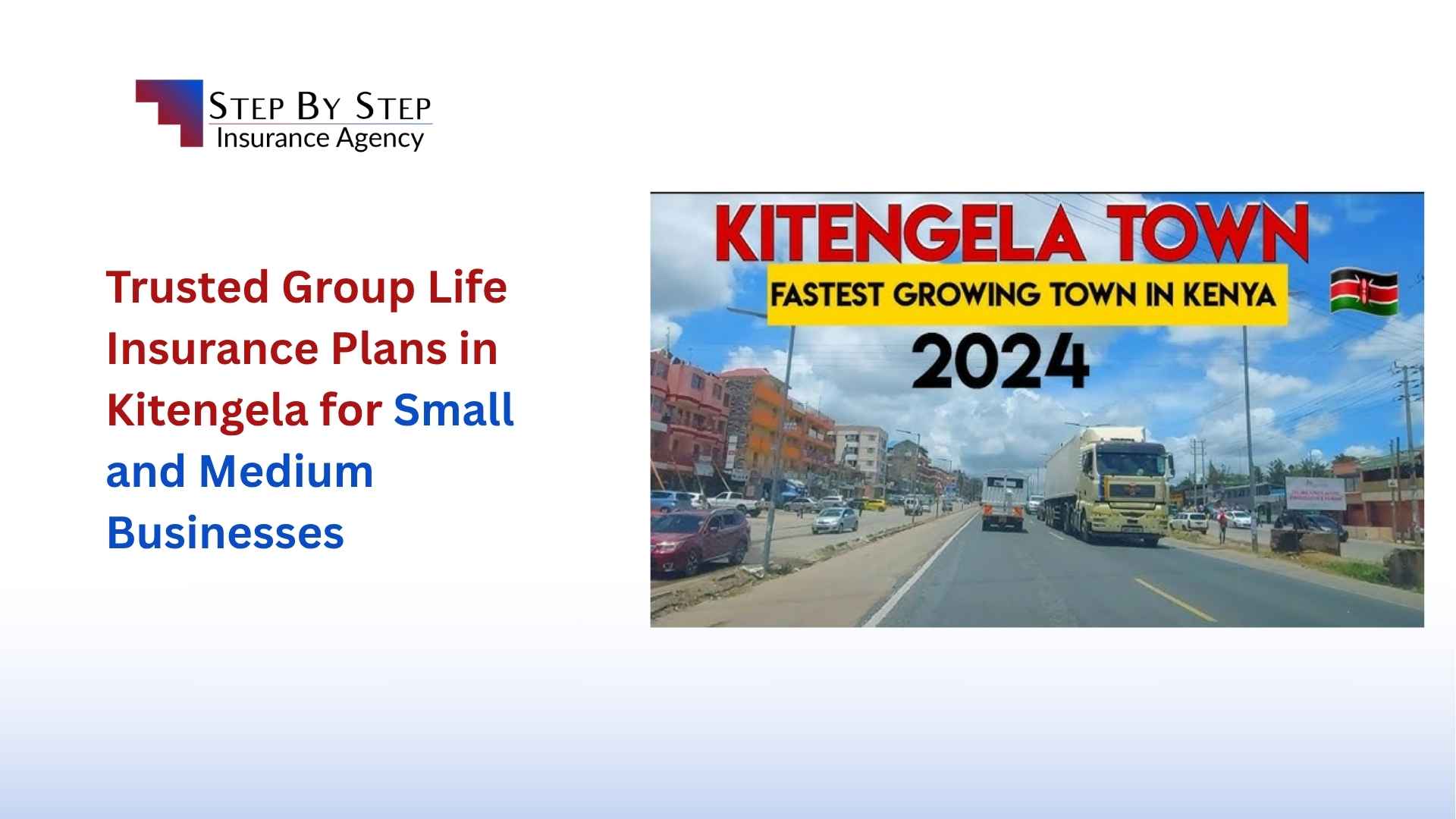
Trusted Group Life Insurance Plans in Kitengela for Small and Medium Businesses
As Kitengela rapidly evolves into a hub for entrepreneurs and SMEs, small and medium-sized businesses are under growing pressure to attract, retain, and protect their workforce. One of the most effective and affordable ways to do that is through group life insurance.
At Step by Step Insurance, we understand the needs of businesses in Kitengela and across Kajiado County. That’s why we offer trusted, flexible, and scalable group life insurance plans tailored to your team size and budget.
Key Takeaways
Group life insurance is an affordable solution for employee protection
Enhances employee loyalty and job satisfaction
Position your business as a caring, responsible employer
Group life insurance is a policy taken out by a business or organization to cover its employees. In the unfortunate event that a team member passes away, the policy pays a lump sum benefit to their family or next of kin.
Benefits for Employers
Benefits for Employees
Enhances employee loyalty and job satisfaction
Peace of mind for families
Demonstrates care and responsibility
Access to affordable life cover
May qualify for tax benefits
No medical exams required for basic coverage
Why Kitengela SMEs Should Consider Group Life Insurance
Kitengela is booming—with new businesses, factories, SACCOs, and tech start-ups emerging every month. However, competition for skilled labor is fierce, and offering employee benefits is now a major differentiator.
Providing group life insurance:
Positions your business as a caring, responsible employer
Helps attract and retain top talent
Provides support to families during difficult times
Builds trust with your team and within the local community
How to Choose a Trusted Insurance Provider in Kitengela
Not all insurance providers are created equal. When selecting a group life insurance partner, consider the following:
Are they licensed and regulated by IRA Kenya?
Do they have experience with SMEs and group plans?
Do they offer local support in Kitengela?
How quick is their claims process?
With Step by Step Insurance, you get the advantage of working with a locally-based, trusted broker who partners with top-tier insurers like Britam, Jubilee, ICEA Lion, and more.
Why Choose Step by Step Insurance in Kitengela
As a leading insurance broker in Kitengela, we specialize in serving small and medium businesses. Here’s what sets us apart:
Personalized advice and needs analysis
On-site consultations at your business premises
Claims support when you need it most
Access to affordable group life insurance plans from leading insurers
Fast, paperless quotes and enrollment
“We believe in protecting the people who power your business.”
How to Get Started
Getting covered is fast and easy:
1. Request a consultation with one of our local insurance advisors
Offering group life insurance in Kitengela is more than a business decision—it’s a way to support your employees, improve morale, and stand out in a competitive market. Whether you’re a growing SME or an established organization, Step by Step Insurance is here to guide you every step of the way.
Secure your team’s future. Start building a safer workplace today.
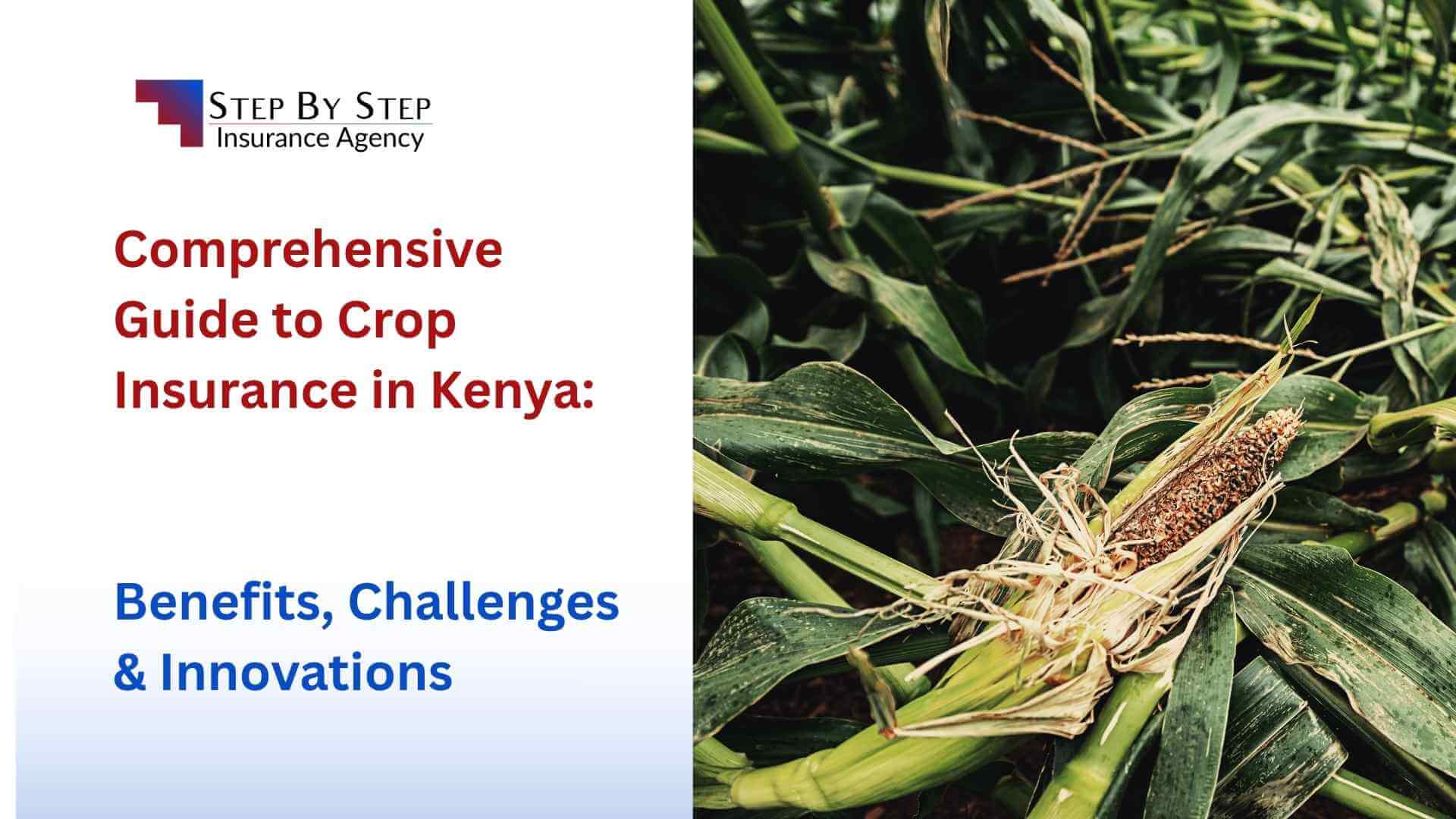
Crop insurance in Kenya offers essential financial protection to farmers—especially smallholders—against losses caused by drought, floods, hail, pests, diseases, and fire. Designed as a vital risk‑management tool, these insurance products help secure livelihoods, support credit access, and contribute to national food security. Yet uptake remains low, at under 1% of farmers, highlighting room for growth and innovation.
🔑 Key Takeaways
Agriculture contributes 33% of Kenya’s GDP but farmers face significant climate risks
Less than 1% of Kenyan farmers currently have crop insurance coverage
Index-based insurance enables faster payouts with minimal paperwork
Bundled insurance with inputs increases adoption rates significantly
Public-private partnerships are expanding access to affordable coverage
Agriculture accounts for roughly 33% of Kenya’s GDP and employs over 40% of the workforce. Smallholders are particularly vulnerable to climate shocks and pests. Between 2019 and 2022, increasing drought severity put millions at risk of food insecurity, with 5.4 million Kenyans facing acute shortages in 2022 alone United Nations | UNSGSA Queen Máxima | IFAD.
Despite the scale of risk, less than 1% of Kenyan farmers currently benefit from insurance payouts, according to the 2021 FinAccess Household Survey United Nations | UNSGSA Queen Máxima.
🧾 Types of Crop Insurance Products
1. Index-Based Insurance (IBI)
IBI triggers payouts when a measurable indicator—like rainfall, temperature, or zonal yield—crosses a threshold. This enables fast, algorithmic disbursements with minimal field verification, though it carries basis risk, meaning the index may not reflect individual farmer losses accurately Wikipedia | arXiv.
2. Area‑Yield Index Insurance (AYII)
Pioneered by Pula Advisors, AYII marries rainfall and yield data across zones. Field enumerators conduct crop sampling to validate payout triggers, reducing basis risk compared to pure index models United Nations | UNSGSA Queen Máxima | IFAD.
3. Multi-Peril Crop Insurance (MPCI)
This classical model entails field assessments by loss adjusters and compensates crop losses from defined perils (drought, pests, fire, hail). It suits larger farms but has higher administrative costs and slower payouts.
📉 Uptake & Performance—A Closer Look
The KCEP‑CRAL programme, funded by IFAD and the EU and implemented in ASAL counties (Embu, Kitui, Makueni, etc.), bundled AYII embedded with input support. About 107,000 farmers enrolled over six seasons, with 52% receiving payouts, averaging KSh 2,855 per farmer—roughly $26 USD, which was about 1.5× their premium paid Business Daily Africa | IFAD.
In 2021, payouts to 13,523 farmers in coastal Kenya totaled KSh 85.1 million, through a partnership between Pula, APA Insurance, and the Kenyan government United Nations | Business Daily Africa.
Farmers overwhelmingly recognized value: 81% would recommend bundled insurance with inputs to peers; 83–93% requested mandatory inclusion of insurance with input distribution—even in areas with low payouts.
Index-based insurance solutions for informal businesses
🏛️ Leading Providers & Public-Private Collaboration
Pula Advisors
Founded in 2015 by Rose Goslinga and Thomas Njeru, Pula has disbursed coverage to over 4.3 million smallholder farmers across 22 African countries, including over two million in Kenya. Their digital pricing platform, Pula Insurance Engine (PIE), facilitates low-cost, transparent underwriting and payout processes Wikipedia | Business Daily Africa | United Nations.
APA Insurance
APA often serves as lead insurer across embedded models developed by Pula. In 2021, Pula delivered payouts together with APA to thousands of farmers in drought-affected counties Business Daily Africa.
CIC Insurance Group
A major micro‑insurance and cooperative insurer, CIC offers MPCI products for crops and livestock, tailored to smallholder and commercial farmers alike Wikipedia.
Other Players
Traditional insurers like Old Mutual / UAP, Britam, and Jubilee offer MPCI or hybrid solutions, often in collaboration with banks and cooperatives.
Government & IFAD
The Ministry of Agriculture and Livestock Development (MoALD) and IFAD’s INSURED program coordinate input‑bundled AYII insurance, public-private partnerships, and agricultural extension support in ASAL counties Reddit | IFAD.
🤝 How Step by Step Insurance Agency Partners to Deliver Value
Step By Step Insurance Agency serves as a specialized intermediary connecting farmers with top insurers like CIC, APA, Britam, and Old Mutual. Their model delivers affordability, personalized support, and fast claims assistance:
Network of insurers: They work with insurers offering index, hybrid, and MPCI products tailored to crop type and farm scale.
Affordable packages: Microinsurance and crop cover starting from KES 3,000 per season, suitable for smallholder budgets.
Claims support: They assist in loss notification, documentation, and liaison with IRA or insurers to expedite settlements.
Application support: Guidance in completing forms, providing land documentation, and planning premium payments. Premier payment channels include M‑Pesa and installments.
📝 Claims Process & Compensation Mechanics
MSP Flow:
Immediate notification—within 72 hours of loss via SMS, call, or agent.
Claim form submission, including incident details and proof.
Claim registration—insurer logs claim and assigns ID.
Loss assessment—automatic index trigger (IBI) or field adjuster visit (MPCI/AYII).
Adjudication—insurer confirms eligibility.
Payout or denial, with appeals via IRA for unresolved disputes.
Payout timelines:
Index-based policies: 2–4 weeks
Field‑assessed (MPCI/AYII): 4–8 weeks
Delays often stem from missing evidence or documentation disputes.
💵 Premium Structure & Subsidies
Premiums are influenced by crop type, region, number of perils, and coverage level:
Old Mutual / UAP’s MPCI: Premiums range from 4.5–15% of the sum insured; supports early payouts to facilitate replanting.
APA Insurance: Minimum premium of about KES 5,000, covers major perils like drought, pests, fire, and excess rain.
Pula’s embedded AYII model: Premiums are bundled with input subsidies or loan credit; often free at point of use to the farmer, paid by suppliers/government.
Government or donor‑supported programmes (e.g. KCEP‑CRAL) frequently subsidize premiums—sometimes up to 50%, making policies more accessible to smallholders.
💡 Innovations Driving Adoption
📦 Embedded Insurance with Inputs
Bundling insurance with fertilizer or seed inputs ensures higher adoption. Farmers receiving inputs via e-vouchers or input credit automatically get insurance coverage—many reported they’d not buy inputs without insurance included.
🌐 Mobile & Digital Platforms
Solutions leveraging M‑Pesa, SMS, national IDs, and mobile apps streamline enrollment, notifications, and claims. Digital record‑keeping reduces paperwork and speeds processing.
🌍 Satellite & AI-Guided Risk Assessment
Tech-driven platforms like Pula’s PIE utilize remote sensing, satellite yield estimates, and machine learning to accurately calculate risk zones and monitor crop health, minimizing basis risk and administrative complexity.
🏛️ Public-Private Initiatives
Government programmes such as KCEP‑CRAL support embedded insurance models in target counties, often with donor backing and technical assistance.
🚧 Ongoing Challenges & Learning
Low insurance literacy: Farmers are wary of “buying promises” and require strong trust-building outreach and extension support.
Basis risk remains: High local variation means index thresholds don’t always reflect individual loss—field-assessed AYII helps, but limitations remain in large heterogeneous zones.
Awareness and education gaps: Over 250–400 communications targeting other government programmes can drown messaging about insurance features—blended digital and in-person training is necessary.
Affordability: Even with subsidies, smallholders find premiums prohibitive unless bundled with inputs.
Claims delays: Farmers lose trust if payouts are delayed or denied without clear communication or transparent fallback options.
👩🌾 Farmer Impact Stories
In Kwale County, a hesitant farmer named Fatuma Rashid purchased a Pula‑enabled AYII policy (~KSh 1,200). A subsequent drought triggered a payout of KSh 85 million across the region. The payout helped pay school fees and secure food for the season. Eventual trust in the policy led others to adopt it the following year IFAD.
In Kisumu region, farmers like Onesmus and Dorcas received payouts of approx. KSh 6,000–9,000. These funds were used for school fees and investing in farm expansion—from four to six acres—rather than resorting to loans or asset sales. Both farmers became local champions promoting insurance benefits in their communities United Nations | UNSGSA Queen Máxima.
🔭 Future Directions & Opportunities
Expand embedded insurance models—partner with more input suppliers and agri‑tech firms to bundle credit and insurance.
Deploy more weather stations and refine zone definitions—reduce basis risk and establish hyper-local indices.
Scale digital education channels—use M‑Pesa, extension agents, and SMS for farmer onboarding and proactive awareness.
Strengthen regulatory oversight—IRA’s role continues in consumer protection, dispute resolution, and enhancing underwriting standards.
Accelerate technology adoption—use satellite imagery, AI analytics, and mobile tools to improve accuracy and speed.
Promote women & youth inclusion—data from KCEP‑CRAL show women comprised 57% of clients receiving payouts, improving financial inclusion and resilience.
✅ Summary Table of Providers & Product Features
Provider
Product Type
Premium Structure
Claims & Payout
Target Farmer
Pula Advisors + APA
AYII (embedded index/yield)
Bundled via input voucher; minimal direct cost to farmers
Index trigger + field samples; payouts in 2–4 weeks
Smallholder farmers under public programs
CIC Insurance Group
MPCI (perils-based)
Microinsurance premiums; based on acreage & risk
Field-adjusted claims, 4–8 weeks
Smallholders and commercial farmers
Old Mutual / UAP
MPCI (multi-peril cover)
4.5–15% of insured sum
Field-based assessment; early payouts possible
Commercial and cooperative farmers
Step By Step Agency
Broker/Advisor across insurers
Premiums from KSh 3,000, flexible payment
Full application & claims assistance
Low‑income smallholders
🔎 Conclusion
Crop insurance in Kenya is a powerful tool for weathering climate shocks, protecting income, and enabling agricultural investment. Innovations such as embedded AYII programs, mobile-based enrollment, and partnerships between Pula, APA, CIC, Old Mutual, and service agencies like Step By Step are revolutionizing access.
Yet, challenges persist—insurance literacy, affordability, basis risk, and claims delays remain barriers. Continued collaboration among government agencies, insurers, fintech innovators, extension services, and local agents will be critical to scaling insurance access.
By protecting smallholder farmers, crop insurance not only supports individual resilience but also strengthens national food security and economic stability. Tools like Pula’s digital AYII products and Step By Step’s inclusive brokerage model exemplify scalable solutions for Kenya’s diverse agricultural landscape.
Ready to Protect Your Farm?
Get personalized advice and find the best crop insurance solution for your needs.