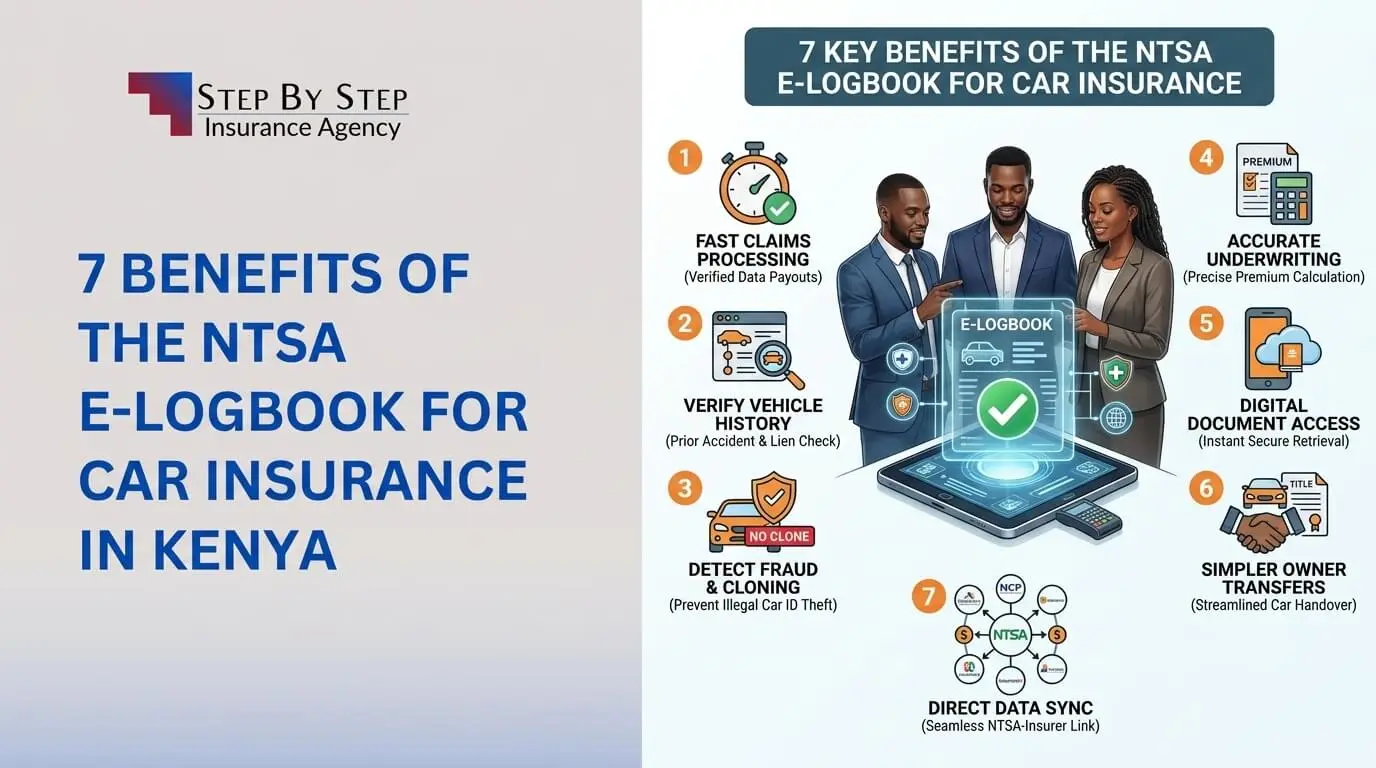
7 Benefits of the NTSA e-Logbook for Car Insurance in Kenya

Kenya’s motor vehicle landscape is undergoing its most significant transformation in decades. On June 10, 2026, the National Transport and Safety Authority (NTSA) officially phases out physical paper logbooks and replaces them with digital e-Logbooks — a move that will ripple far beyond vehicle registration. If you own a car in Kenya, you need to understand exactly how this shift affects your car insurance: from how insurers verify your vehicle, to how quickly your policy gets processed, to what happens if you’re stopped at a police roadblock.
This guide breaks it all down in plain language.
- The NTSA e-Logbook launches June 10, 2026, replacing physical paper logbooks via the eCitizen platform.
- Insurers will verify your vehicle instantly via QR code — eliminating reliance on paper documents that are easy to forge.
- Automated reminders will notify you before your insurance lapses, directly through your eCitizen account.
- Traffic police will have live access to insurance validity and ownership records at every roadblock.
- Ownership transfers will now happen entirely online — removing grey periods that previously caused insurance complications.
- Reduced fraud industry-wide could lead to more competitive premiums for honest motorists over time.
- Action required before June 10: verify your eCitizen account, update contact details, and confirm your insurance is correctly registered.
💬 Stay Ahead of Insurance News in Kenya
Join our WhatsApp community of Kenyan motorists, brokers, and insurance enthusiasts. We share the latest insurance industry updates, regulatory changes, tips, and market news — no spam, no clickbait.
Join the Community- What Is the NTSA e-Logbook?
- 7 Key Ways the e-Logbook Affects Your Car Insurance
- Insurers Can Now Verify Your Vehicle in Seconds
- Automated Insurance Renewal Reminders
- Real-Time Insurance Validity Checks at Roadblocks
- Faster and More Secure Claims Processing
- Comprehensive Cover and Logbook Financing
- Reduced Insurance Fraud — Better Rates for Honest Motorists
- What Happens to Your Insurance When Ownership Transfers
- Step-by-Step: What You Need to Do Before June 10
- What About Your Physical Logbook?
- The Bigger Picture: A Safer Insurance Market
- Frequently Asked Questions
| 📄 Resource | Topic | Type |
|---|---|---|
| Why Motor Insurance Claims Delay in Kenya | Claims processing, common delays, tips to speed up | Guide |
| Private Motor Insurance in Kenya — Complete Guide | Cover types, premiums, what’s included | Guide |
| Get a Motor Insurance Quote | Instant quote for your vehicle | Tool |
| Contact / Request a Consultation | Speak to a licensed insurance advisor | Contact |
What Is the NTSA e-Logbook?
The NTSA e-Logbook is a fully digital vehicle registration certificate that replaces the traditional paper logbook Kenyan motorists have relied on for decades. Accessible through the government’s eCitizen platform, it stores all vehicle ownership records in a secure, real-time digital database.
NTSA Director General Eng. Nashon Kondiwa announced the rollout during the 3rd Annual Regulatory Authorities and Agencies Conference at South Eastern Kenya University in May 2026, describing it as a shift from “a reactive, paper-based registry that is prone to fraud, delays, and errors” to “a proactive, real-time digital system with strong integrity controls and automated lifecycle management.”
In simple terms: your vehicle’s ownership history, inspection records, insurance validity, and transfer details will all live in one secure, instantly accessible digital record — and your insurer, your bank, and the traffic police will be able to read it with a single scan.
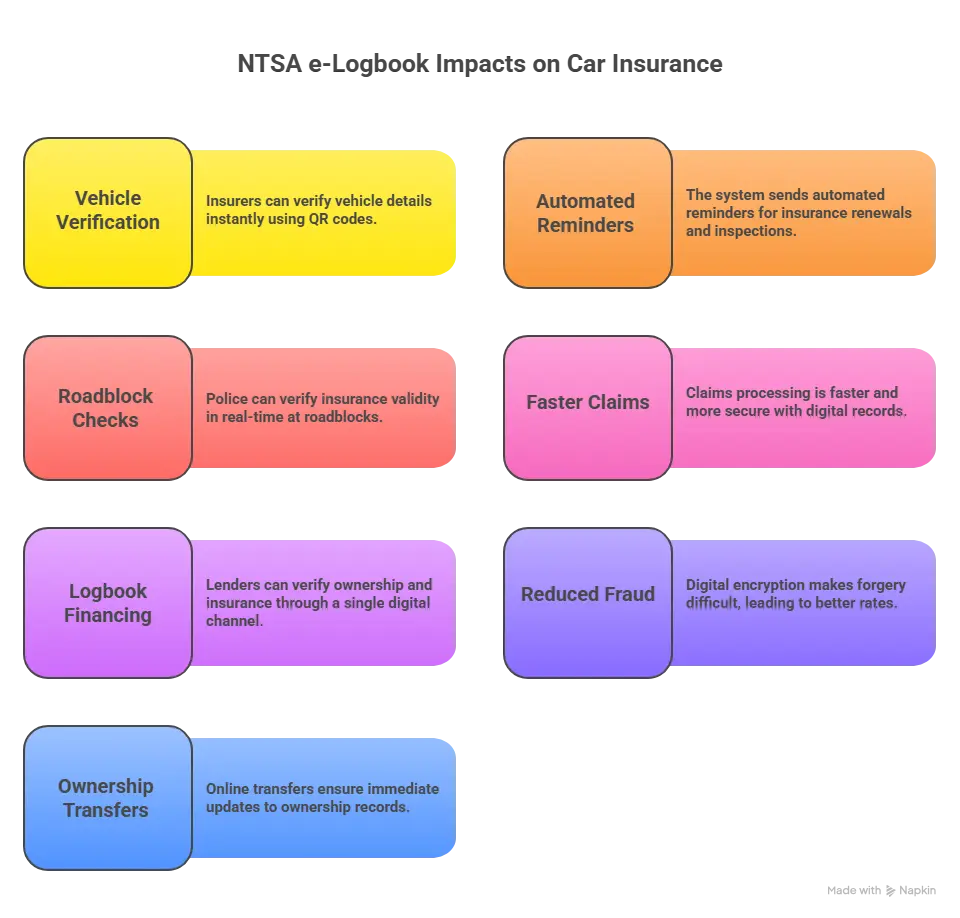
7 Key Ways the NTSA e-Logbook Affects Your Car Insurance in Kenya
1. 🔍 Insurers Can Now Verify Your Vehicle in Seconds
One of the most direct impacts on car insurance is the speed and accuracy of vehicle verification. Under the old system, insurance underwriters had to rely on physical logbooks — documents that were frequently forged, damaged, or out of date. This created significant fraud risk for insurance companies, delays during the underwriting process, and ultimately higher premiums for honest policyholders.
The e-Logbook changes this fundamentally. Each digital certificate contains a dynamic QR code embedded with encrypted vehicle data. Insurance companies can scan this QR code to instantly confirm:
- The registered owner’s identity
- Whether the vehicle has any active liens or financing encumbrances
- The vehicle’s inspection history
- Any previous insurance claims or stolen vehicle flags
NTSA has confirmed that “buyers, insurers, and financial institutions can scan to verify authenticity and ownership instantly.” For you as a policyholder, this means less paperwork when taking out a new policy, faster claim processing, and — over time — potentially lower premiums as insurers gain confidence in the data they are working with.
2. 🔔 Automated Insurance Renewal Reminders
Driving an uninsured vehicle in Kenya is both illegal and financially devastating if you are involved in an accident. Yet thousands of Kenyan motorists find themselves lapsing on insurance renewal — often simply because they forgot or didn’t receive a timely reminder.
The e-Logbook system directly addresses this through automated alerts. NTSA has confirmed that the platform will send vehicle owners timely notifications before their insurance coverage expires, alongside reminders for inspection deadlines and other compliance requirements. The Star reported that “vehicle owners will receive notifications for insurance renewals, inspection deadlines and other compliance requirements,” with NTSA framing this as a tool to “help motorists remain compliant and reduce cases of uninsured or unroadworthy vehicles on Kenyan roads.”
3. 🚔 Real-Time Insurance Validity Checks at Roadblocks
Currently, traffic police officers rely on physical insurance stickers on windscreens and paper certificates to verify a vehicle’s insurance status at roadblocks. Fake insurance documents have been a persistent problem in Kenya, with some motorists purchasing fraudulent certificates from informal brokers.
Under the e-Logbook system, this loophole closes significantly. NTSA has confirmed that “police and inspection units will have live access to vehicle ownership records, insurance validity, stolen vehicle status and inspection history.” An officer will be able to scan your e-Logbook QR code on a smartphone or connected device and see, in real time, whether your insurance is valid — not just whether you have a sticker on your windscreen.
4. 📋 Faster and More Secure Claims Processing
Filing a car insurance claim in Kenya has traditionally involved a mountain of paperwork: submitting certified copies of your logbook, police abstracts, and ownership documents — all to confirm that the vehicle being claimed for is genuinely yours. Any mismatch between documents could stall or derail your claim entirely. If you’ve experienced this before, our guide on why motor insurance claims delay in Kenya explains the structural reasons behind it.
With the e-Logbook, your ownership record is immutable and real-time. An insurance assessor processing your claim can access the NTSA system directly to confirm vehicle details without waiting for physical documents. This should significantly reduce the time between filing a claim and receiving a payout — a persistent complaint among Kenyan motorists.
Additionally, the encrypted nature of the e-Logbook makes it much harder for fraudsters to submit claims for vehicles they do not own. This reduction in insurance fraud is expected to have a long-term downward pressure on premiums across the market.
5. 🏦 Comprehensive Cover and Logbook Financing — A Cleaner Connection
Many Kenyan motorists use their logbook as collateral to access vehicle financing through banks and SACCOs. Under the old system, lenders had to call NTSA, visit offices, or rely on physical copies to confirm that a logbook was genuine and unencumbered. This process was slow and sometimes manipulated, with some borrowers pledging the same vehicle to multiple lenders simultaneously.
NTSA has directly addressed this: “Banks and SACCOs can directly verify ownership and lien status via the NTSA system, reducing the need for physical file copies and speeding up loan approvals for vehicle financing.” For motorists with comprehensive insurance policies — which many lenders require as a condition for vehicle financing — this integration means lenders can verify both your ownership and your insurance cover through a single digital channel.
6. 🛡️ Reduced Insurance Fraud — Better Rates for Honest Motorists
Insurance fraud in Kenya has long been a costly problem. Fake logbooks enabled criminals to insure stolen vehicles, submit inflated claims, or take out policies against vehicles they did not legally own. This cost had to be absorbed somewhere — and it ended up in higher premiums for every policyholder in the market.
The e-Logbook system’s digital encryption and secure hashing technology make document forgery dramatically more difficult. NTSA has stated that “the e-Logbook system uses digital encryption and secure hashing technology to protect vehicle owners from forgery and fraud commonly associated with paper documents.”
As fraud-related losses decline across the insurance industry, insurers will have less reason to inflate premiums to cover these losses. While premium reductions are not guaranteed or immediate, the structural conditions that kept them artificially high will begin to change. Motor vehicle insurers in Kenya who adopt the e-Logbook verification system into their underwriting processes will be able to price risk more accurately — rewarding clean, verifiable vehicle histories with more competitive rates. Learn more about how the IRA regulates motor insurance pricing in Kenya.
7. 🔄 What Happens to Your Insurance When Ownership Transfers
Buying or selling a second-hand car in Kenya has always come with insurance complications. If you buy a vehicle and the ownership transfer takes weeks to process, there is a grey period during which the insurance policy is technically under the previous owner’s name. This creates genuine risk for the new buyer.
The e-Logbook eliminates this ambiguity. Ownership transfers will now be completed entirely online via the eCitizen platform, with no need to visit NTSA offices or wait for manual stamping. Ownership records update in real time the moment a transfer is accepted. This means:
- New buyers can immediately apply for insurance in their own name
- There is no grey period of uncertain ownership
- Insurers can confirm the new owner’s status instantly before issuing a policy
Step-by-Step: What You Need to Do Before June 10, 2026
Here is a practical checklist for every Kenyan car owner to ensure your insurance situation is clean under the new e-Logbook system:
-
Access Your eCitizen Account
Log in at ecitizen.go.ke and confirm your vehicle appears under your profile. If you have never set up an eCitizen account, do so now — this is the gateway to your e-Logbook. -
Verify Your Contact Details Are Current
Update your phone number and email on the eCitizen platform. Automated insurance renewal reminders and compliance alerts will be sent to these contacts. -
Confirm Your Insurance Is Registered Correctly
Use *352# (USSD), the AKI app, or the Bima Yangu app to verify your current motor insurance policy is registered and showing as genuine in the national database. If it shows invalid or not found, contact your insurer immediately. -
Update Your Insurer With the Correct Vehicle Details
Confirm that your insurance certificate reflects the same vehicle details that appear in your NTSA record — registration number, make, model, year, and engine capacity. Any mismatch could create complications during claims processing once insurers begin querying the e-Logbook system. -
If You Have Recently Bought or Sold a Vehicle, Complete the Transfer
Incomplete logbook transfers create insurance complications. Ensure the NTSA TIMS transfer process is finalised so insurance records align with actual ownership. -
Collect Any Pending Physical Logbooks
NTSA has noted that thousands of logbooks remain uncollected at their offices. If you have applied for a new or replacement logbook, collect it before June 10. Physical logbooks remain valid during the transition period, but you want your records complete before the digital switchover. -
Attend or Watch NTSA’s Sensitisation Sessions
NTSA has scheduled public education forums from June 2 to June 4, 2026, conducted virtually. These sessions are designed for motorists, insurers, dealers, and financial institutions. Attend to understand how the system will work in practice.
What About Your Physical Logbook?
A common question among Kenyan motorists is whether they need to discard their existing physical logbooks immediately. NTSA has been clear on this: physical logbooks remain valid registration certificates and should be kept safely during the transition period. They will continue to be used alongside e-Logbooks until the full switchover is complete. In some cases, however, you may be asked to surrender the physical copy during replacement or conversion processes.
The Bigger Picture: A Safer, More Transparent Insurance Market
The NTSA e-Logbook is more than a paperwork upgrade. It represents a fundamental shift in how vehicle identity and ownership are established in Kenya — with direct consequences for the entire motor insurance ecosystem.
For insurers, it means access to accurate, tamper-proof vehicle data that they can query in real time. For motorists, it means fewer fraudulent competitors inflating premiums, faster claims processing, and less bureaucratic friction when taking out or renewing a policy. For law enforcement, it means the ability to confirm insurance validity, ownership, and inspection status at any roadblock — removing the last refuge of the fraudulent insurance sticker.
Kenya’s motor insurance market has long been complicated by information asymmetry: insurers not trusting the documents they receive, motorists not trusting the process, and fraudsters exploiting every gap. The e-Logbook, when fully implemented, narrows those gaps substantially.
The transition begins June 10, 2026. The question is not whether it will affect your car insurance — it will. The question is whether you will be prepared.
Frequently Asked Questions
Your existing policy remains valid until its expiry date. However, your insurer will increasingly verify vehicle details through the e-Logbook system when you renew or make changes to your policy. It’s wise to ensure your records are aligned well before renewal.
Contact both NTSA and your insurer immediately to reconcile the records. Mismatches can delay claims processing and cause complications at roadblocks. Don’t wait until you need to make a claim to discover the discrepancy.
Police can flag insurance discrepancies they find through the system. If your insurance appears expired or invalid in the digital database, you may face enforcement action even if you have a physical certificate. Always verify your policy status using *352# or the AKI/Bima Yangu apps.
Visit the nearest NTSA office, the NTSA Help Desk at Huduma Kenya Centres, or email info@ntsa.go.ke. You can also visit ecitizen.go.ke directly and follow the registration steps online.
🚗 Ready for Kenya’s New Digital Vehicle Era?
Need to review or update your motor insurance policy ahead of the e-Logbook rollout? Speak to a licensed insurance advisor today to ensure your cover is correctly registered and compliant.