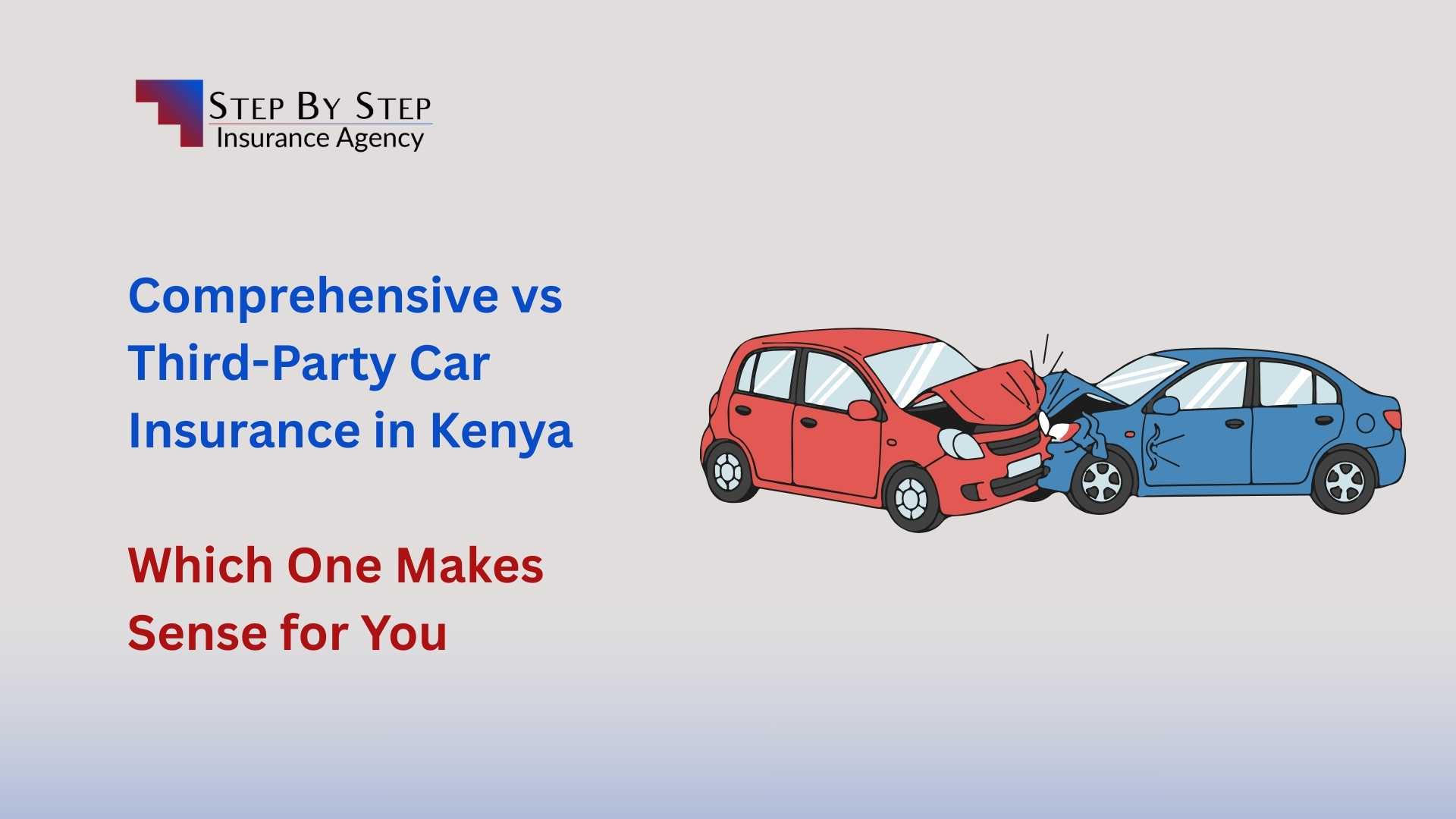
Third-Party vs Comprehensive Car Insurance in Kenya – A Clear Guide
Car insurance in Kenya isn’t just about complying with the law — it’s about protecting your finances, your vehicle, and your peace of mind.
The Insurance Regulatory Authority (IRA) requires every vehicle on Kenyan roads to have at least Third-Party insurance. But beyond meeting the legal requirement, many drivers find themselves asking:
Should I choose Third-Party only… or invest in Comprehensive cover?
Let’s break it down clearly and simply so you can make a confident, informed decision.
Key Takeaways
Third-Party is the minimum legal requirement and covers damage you cause to others, but not your own vehicle.
Comprehensive covers both third-party liabilities and damage or loss to your own car from accidents, theft, fire, and natural disasters.
The right choice depends on your car’s value, budget, driving habits, and personal risk tolerance.
Professional guidance can help you navigate options and find the most suitable and cost-effective cover for your specific situation.
Are you interested in staying updated on insurance trends, news, and insights in Kenya? Join our dedicated WhatsApp group to connect with a community of like-minded individuals. Share experiences, ask questions, and stay informed.
Third-Party insurance is the minimum legal requirement in Kenya.
✅ What it covers:
Injuries caused to other people
Damage to other people’s vehicles or property
Legal liability arising from an accident
❌ What it does not cover:
Damage to your own vehicle
Theft of your vehicle
Fire or flood damage
Your own medical expenses
In simple terms, Third-Party protects you against claims from others — but it does not protect your own car.
It is a cost-conscious option for drivers who mainly want to meet legal requirements while keeping premiums manageable.
What Is Comprehensive Car Insurance?
Comprehensive insurance provides broader protection. It includes Third-Party cover and also protects your own vehicle.
✅ Typically covers:
Accidental damage to your car (even if you are at fault)
Theft or attempted theft
Fire damage
Natural disasters such as floods or storms
Third-party injuries and property damage
Many Comprehensive policies also allow optional add-ons such as:
Windscreen cover
Roadside assistance
Towing services
Personal accident benefits
In short, Comprehensive cover protects both you and other road users.
Comprehensive vs Third-Party: Quick Comparison
Feature
Third-Party Only
Comprehensive
Legal requirement
Yes
Yes
Covers damage to others
Covers your own car
Theft & fire
Natural disasters
Premium cost
Lower
Higher
Peace of mind
Basic
High
Pros and Cons at a Glance
Third-Party Insurance
Pros
More affordable premiums
Meets legal requirements
Suitable for drivers seeking basic liability protection
Cons
No protection for your own vehicle
Repair costs come out of your pocket
No cover for theft, fire, or natural disasters
Comprehensive Insurance
Pros
Protection for your own vehicle
Covers theft, fire, floods, and accidents
Optional add-ons for additional security
Greater financial protection
Cons
Higher premiums
May not always be cost-effective for very old vehicles
How Do You Decide What’s Right for You?
Choosing between Third-Party and Comprehensive depends on your personal situation. Here are the key factors to consider:
1. Your Car’s Value
If your vehicle is new or has significant market value, Comprehensive cover may offer better financial protection.
If your car has a lower value, Third-Party may be a practical option.
2. Your Budget
If unexpected repair or replacement costs would significantly affect your finances, Comprehensive cover offers added financial security.
3. Your Driving Environment
Frequent driving in busy cities, highways, or high-traffic areas increases the likelihood of accidents. Broader protection may be worth considering.
4. Your Risk Tolerance
Ask yourself: If something happens to my car tomorrow, would I be financially prepared to handle it?
Your answer can guide your decision.
Real-Life Scenarios
New car owner in Nairobi: Comprehensive cover is often recommended due to higher traffic risk and vehicle value.
Older vehicle used occasionally: Third-Party may provide adequate protection while keeping costs low.
Family or business vehicle: Comprehensive cover can offer important financial stability in case of unexpected events.
How Step by Step Insurance Helps You Choose
At Step by Step Insurance, we believe insurance decisions should be informed — not rushed.
Instead of offering one-size-fits-all solutions, we take time to understand:
Your vehicle type and value
Your budget
How and where you drive
Your personal risk level
Here’s how we support you:
We compare multiple insurers to help you get competitive value
We explain policy details in simple, clear language
We help you choose meaningful add-ons — not unnecessary extras
We assist you through the claims process from start to finish
We give honest advice — even when a lower-cost option makes more sense
Our goal is straightforward: to match you with insurance that truly protects you — not just something that looks affordable on paper.
Frequently Asked Questions
Can I upgrade from Third-Party to Comprehensive later?
Yes. In many cases, you can upgrade during renewal or mid-term, subject to vehicle inspection and insurer approval.
Is Comprehensive always better?
Not necessarily. The right choice depends on your vehicle’s value, financial position, and comfort with risk.
Does Third-Party cover passengers?
It may cover third-party passengers, but cover for your own injuries typically requires personal accident benefits, which are usually an add-on or part of a Comprehensive policy.
Final Thoughts
There is no universal “best” car insurance in Kenya.
Third-Party offers legal compliance and basic liability protection. Comprehensive provides broader financial protection and greater peace of mind.
The right choice depends on your car, your budget, and your lifestyle.
If you’re unsure, that’s exactly where professional guidance makes a difference.
Ready to Choose the Right Cover?
Talk to Step by Step Insurance today for a free consultation and personalized quote. We’ll walk with you — step by step — until you’re confidently protected.
Motor Insurance in Kenya (2026): The Complete Step-by-Step Guide
Motor insurance is one of the most essential covers in Kenya. It protects you from major financial loss when your vehicle is involved in an accident, theft, fire, or third-party claim.
But many people buy motor insurance without fully understanding:
what it covers
what it doesn’t cover
how claims work
why excess matters
how insurers calculate payouts
This guide explains everything clearly, step-by-step.
Key Takeaways
Motor insurance in Kenya comes in three main types: Comprehensive, Third Party Fire & Theft, and Third Party Only
Comprehensive cover protects both your vehicle and third-party liabilities, making it ideal for newer or high-value cars
Understanding excess (the amount you pay during claims) is crucial to avoid surprises
Underinsurance can significantly reduce your payout – always insure at market value
Immediate accident reporting and proper documentation are essential for smooth claims processing
Optional add-ons like windscreen cover and excess buyback can provide valuable additional protection
Stay updated with the latest insurance trends, news, and expert insights. Join our WhatsApp community of insurance enthusiasts and professionals in Kenya.
✅ If the vehicle is declared a total loss, the maximum payable is based on the vehicle’s value just before the accident.
B) Market Value (How Your Car Payout Is Calculated)
If your car is written off, the payout is based on your car’s pre-accident market value, not sentimental value.
Tip: Review your value every year so you don’t underinsure.
C) Recovery and Towing (After an Accident)
If your vehicle cannot be driven after an accident, your cover may help pay for:
towing/recovery
moving the vehicle to the nearest repairer
moving the vehicle to a safe place
⚠️ Note: This benefit usually has a limit, so it’s not “unlimited towing.”
D) Small Repairs (Authorized Repair Limit)
Some motor covers allow minor repairs without long approvals—up to a specific limit.
This helps in cases like:
minor bumper repairs
small panel work
small parts replacement
✅ You still must send repair costs quickly to the insurer to avoid claim issues.
4) What Motor Insurance Covers for Third Parties
Even if you don’t have comprehensive, third party cover is essential because it protects you from expensive legal liability.
Third party cover can pay for:
✅ Third Party Bodily Injury/Death
Example: you hit a pedestrian or boda boda rider.
✅ Third Party Property Damage
Example: you hit another car, a gate, a wall, or shop property.
Important: Limits Apply
Many policies have limits such as:
maximum payout per person injured
maximum payout per accident/event
maximum payout for property damage
✅ Always confirm your third party limits when choosing a policy.
5) Emergency Medical Expenses (If Included)
Some motor covers provide a small medical expense benefit for injuries resulting from the accident.
This can cover reasonable emergency medical costs for:
the insured
the authorized driver
passengers (depending on policy wording)
✅ It helps especially for minor emergency treatment after accidents.
6) Car in Garage / Service Provider Custody
If your vehicle is at a garage for repairs or servicing, some policies still protect you under certain conditions.
This is helpful because accidents and loss can happen even when the car is not with you physically.
7) What Motor Insurance Does NOT Cover (Common Exclusions)
Even with comprehensive cover, insurers may not pay for certain events.
Exclusion Type
What It Means
Example
Wear and Tear
Normal deterioration over time
Old tyres wearing out naturally
Mechanical Breakdown
Engine/electrical failure not from accident
Engine failure without collision impact
Consequential Loss
Indirect losses from being unable to use car
Loss of business income while car is off road
Contents Damage
Items inside the vehicle
Laptop, phone, cash stolen from car
Overloading
Carrying excessive weight/passengers
Carrying cargo above vehicle capacity
DUI (Driving Under Influence)
Driving while intoxicated
Accident while driver was drunk
Prohibited Use
Using car for purposes not covered
Uber/Taxi without commercial cover, racing
Common exclusions include:
❌ Wear and tear – Example: old tyres wearing out.
❌ Mechanical or electrical breakdown – Example: engine failure without accident impact.
❌ Consequential loss – Example: loss of business income because your car is off the road.
❌ Damage to contents inside the vehicle – Example: laptop, phone, cash, or goods stolen from the car (unless separately insured).
❌ Overloading or strain – Example: carrying cargo above capacity.
❌ Driving under alcohol/drugs – Insurance may reject claims if the driver was intoxicated.
❌ Using the car for prohibited purposes – Example: hire and reward (Uber/Taxi) if not insured for it, racing, commercial delivery if not covered under limitations.
Important: This is why “limitations as to use” is critical.
8) Excess (Deductible): What You Pay During a Claim
An excess is the amount you contribute when a claim occurs.
Common excess types in motor insurance:
Excess Type
When It Applies
Typical Amount
Own Damage Excess
When your car is damaged
Percentage of value + min/max amounts
Third Party Property Damage Excess
When third party property is damaged
Fixed amount (e.g., Ksh 5,000-15,000)
Theft Excess
When vehicle is stolen
Varies based on security devices installed
Young Driver Excess
Driver under certain age (usually 25)
Additional amount on top of regular excess
Why Excess Matters
You can have a valid claim, but still pay part of the cost because excess applies.
Example:
If repairs cost Ksh 200,000 and your excess is Ksh 15,000
➡️ insurer pays Ksh 185,000 (subject to approval)
9) Underinsurance (Average Clause) — Very Important
If your vehicle market value is higher than what you insured it for, insurers can apply the average clause.
Meaning: ✅ they reduce your payout proportionately because you underinsured the car.
Example (simple):
Your car market value: Ksh 1,000,000
You insured it at: Ksh 500,000
➡️ insurer may pay only about 50% of the repair cost.
Kenya’s New Vehicle Valuation Rules: Impact on Car Prices and Insurance
Starting July 1, 2025, Kenya’s automotive and insurance sectors are bracing for a significant shake-up. The Kenya Revenue Authority (KRA) has introduced new valuation rules for used car imports, updating the Current Retail Selling Price (CRSP) schedule for the first time since 2019. This update not only recalibrates how customs duties are calculated but also has far-reaching implications for motor insurance underwriting.
Whether you’re a car buyer, importer, insurer, or industry observer, understanding these changes is essential. This blog dives deep into the new valuation framework, its rationale, the expected impact on vehicle prices, and how motor insurance companies will adjust their underwriting models to reflect the new reality.
Key Takeaways
KRA has updated vehicle valuation rules for the first time since 2019
Taxes on imported used vehicles will increase significantly
Small cars and commercial vehicles face the steepest price hikes
Motor insurance premiums will rise due to higher vehicle values
Insurers are adjusting risk models and claims reserves
Industry reactions are mixed with potential legal challenges
The CRSP is the official price list KRA uses to determine the customs value of imported used vehicles. This valuation forms the basis for calculating multiple taxes, including:
Tax Type
Previous Rate
New Rate
Impact
Import Duty
25%
35%
Significant increase
Excise Duty
20-35%
20-35%
Varies by vehicle type
Value Added Tax (VAT)
16%
16%
No change
Import Declaration Fee
2.5%
2.5%
No change
Railway Development Levy
1.5%
1.5%
No change
The July 2025 update is the most comprehensive revision of the CRSP since 2019. It expands the vehicle database from about 3,000 to over 5,200 models, incorporating detailed trim levels, drivetrain options, and performance specifications. The update also factors in currency depreciation and inflation to reflect current market realities more accurately.
Why the Change? Understanding the Rationale
The last CRSP update was six years ago, and a lot has changed since then. Kenya’s currency has depreciated from roughly KES 100 to KES 130 per US dollar, global vehicle prices have shifted, and the local market has evolved with new models and variants.
KRA’s Objectives with the New CRSP
KRA’s goals with this update are clear:
Enhance transparency and reduce tax evasion by basing valuations on up-to-date, realistic prices
Align import duties with current economic conditions to protect government revenue
Ensure fairer taxation by covering a broader spectrum of vehicle models and specifications
The update followed extensive consultations with industry stakeholders, including car importers, freight forwarders, and dealer associations, ensuring that the new CRSP reflects real-world market trends.
How Will Used Car Prices Change?
The immediate effect of the new CRSP is an increase in the taxable value of many imported used vehicles, leading to higher overall costs for buyers.
Vehicle Category
Example Models
Estimated Price Increase
Primary Reason
Small Cars
Toyota Vitz, Honda Fit
Up to 145%
Higher import duties
Commercial Vehicles
Toyota Probox, Nissan Vanette
30-60%
Increased excise duty
Luxury Sedans
BMW 5 Series, Mercedes E-Class
20-40%
Higher valuation + duties
Performance Vehicles
Porsche 911, BMW M Series
25-45%
Increased excise duty
Luxury SUVs
Range Rover, Mercedes GLE
5-15% decrease
Reclassification benefits
Small cars face the steepest tax hikes, with some models seeing import duty increases of up to 145%. Popular models like the Toyota Probox, a staple for commercial use, will become more expensive due to higher duties. Luxury and high-performance vehicles such as the Porsche 911 Turbo S and BMW M5 will also attract higher taxes because of increased excise duty rates. Interestingly, some luxury SUVs may see marginal tax reductions due to reclassification and updated pricing.
Overall, buyers should expect used car prices to rise by approximately 15-25% in the coming months, reflecting the cumulative effect of higher import duties, excise taxes, and VAT.
Impact on Motor Insurance Underwriting
The ripple effects of the new valuation rules extend beyond the car market into the insurance industry, particularly motor insurance underwriting.
1. Higher Insured Values
Motor insurance premiums are typically calculated based on the insured declared value (IDV) of the vehicle, which closely aligns with the vehicle’s market value. As import duties push up car prices, the IDV will rise accordingly.
2. Adjusted Risk Assessment
Insurers use vehicle value as a key factor in underwriting risk. Higher-valued cars often carry higher risks due to:
Increased repair costs
Greater likelihood of theft or targeting by criminals
Higher costs for spare parts and specialized labor
3. Claims Settlement and Reserves
With increased vehicle valuations, insurers must also adjust their claims reserves to ensure sufficient funds are available to cover potential payouts. This could impact the overall financial health and capital requirements of insurance companies.
The announcement of the new CRSP and associated tax hikes has elicited mixed reactions:
Concerns from Industry Players
Car importers and dealers warn that the increased costs may dampen demand, especially for small commercial vehicles vital to many Kenyans’ livelihoods. Consumers express concern over affordability, fearing that vehicle ownership will become out of reach for many.
Potential Legal Challenges
Some industry players have threatened legal challenges, arguing that the tax increases are excessive and could hurt the economy. Insurers are preparing to update their pricing models and educate customers about the reasons behind premium increases.
Positive Responses
Despite these concerns, many acknowledge that the update was overdue and necessary to curb undervaluation and tax evasion, which have long distorted the market.
Regulatory and Market Outlook
The new valuation rules are part of a broader regulatory push to modernize Kenya’s automotive and insurance sectors:
Alignment with Global Standards
KRA’s move aligns with global customs valuation standards, improving transparency and compliance. Insurance regulators are expected to issue updated guidelines on motor insurance underwriting to reflect the new vehicle valuation landscape.
Market Shifts and Innovations
The market may see a shift in import patterns, with buyers favoring models with lower tax burdens or newer vehicles that offer better value. Insurers might innovate with new products, such as usage-based insurance or microinsurance, to cater to changing consumer affordability.
External Reference
For more information on insurance claims in Kenya, see this recent report:
The July 1, 2025 implementation of new valuation rules for used car imports marks a pivotal moment for Kenya’s automotive and insurance industries. While buyers will face higher vehicle prices, insurers will need to adapt underwriting practices to a new reality of increased insured values and claims costs.
For consumers, understanding these changes helps set realistic expectations about vehicle ownership costs and insurance premiums. For insurers and industry stakeholders, the update presents both challenges and opportunities to innovate and build a more transparent, sustainable market.
Staying informed and proactive will be key as Kenya navigates this significant transition. If you’re involved in buying, importing, or insuring vehicles in Kenya, now is the time to review your plans and prepare for these changes.
stepbystepinsurance
Typically replies within minutes
What type of insurance are you interested in exploring with Step by Step Insurance?
WhatsApp Us
🟢 Online | Privacy policy
WhatsApp us
Scripture Union Building, 1st floor, off Argwings Kodhek road, behind Shell petrol station Hurlingham.