Fire & Perils Insurance Guide in Kenya

Fire can strike without warning. Whether you own a commercial building, run a business, or hold valuable stock and equipment, a single incident can wipe out years of hard work in a matter of hours. Fire & Perils Insurance exists to protect exactly that — your property, your assets, and your livelihood.
This type of insurance covers physical loss or damage caused by fire and a range of associated perils, including lightning, explosion, and in many policies, flooding and storm damage. It can cover the structure of a building, furniture and fittings, machinery, stock-in-trade, goods held in trust, and even rental income.
Before a policy can be issued, your insurer needs to understand the full picture of what is being covered and the risks involved. That is where the proposal form comes in. This guide walks you through every section of a standard Fire & Perils proposal form — using the AAR Insurance Kenya form as a reference — so you can complete it accurately and confidently.
Who should read this?
- Building owners seeking to insure their property
- Business owners with stock, machinery, or equipment on their premises
- Landlords with tenants occupying commercial or mixed-use buildings
- Anyone renewing or switching their existing fire cover
Table of Contents
| Internal resources | Description |
|---|---|
| Home insurance claims rejected? | Understanding claim rejections |
| Combined fire & burglary | Protect your business |
| Contact / consultation | Reach our team |
| Get a quote | Quick premium estimate |
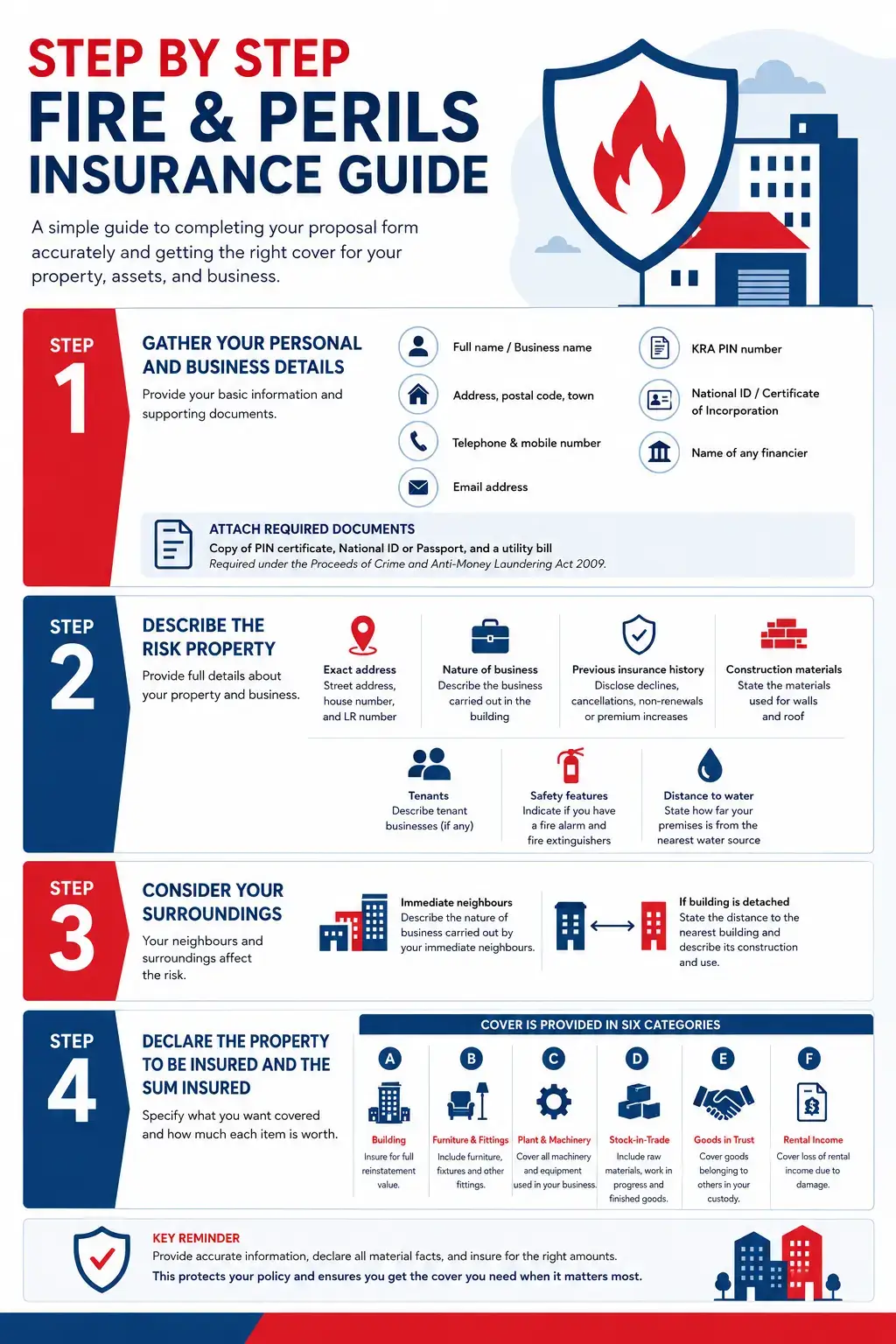
Step 1: Gather Your Personal and Business Details
The first section of the proposal form asks for your basic identifying information. This is straightforward, but it is important to have everything ready before you sit down to complete the form. Incomplete or incorrect details can delay the processing of your application.
What you will need
- Your full legal name or, for a company, the registered business name
- Your postal address, postal code, and town
- A working telephone number and mobile number
- Your email address
- Your KRA PIN number
- Your National ID number or, for companies, your Certificate of Incorporation
- The name of any financier — for example, a bank holding a charge over the property
You will also need to attach supporting documents: a copy of your PIN certificate, National ID or Passport, and a utility bill. These are required under the Proceeds of Crime and Anti-Money Laundering Act 2009 as proof of identity. Do not skip this — missing documents are among the most common reasons for delays.
Step 2: Describe the Risk Property
This section is where the underwriter begins to assess the risk. Every detail you provide here helps the insurer determine both the likelihood of a claim and the appropriate premium for your cover. Answer every question fully — vague or incomplete answers can affect the validity of your policy at claim time.
Location of the premises
You will need to state the exact street address, house number, and the plot or land reference (LR) number of the property. This must be specific — a general area name is not sufficient.
Nature of business
Describe what business you carry out in the building. A hardware store, a school, a printing press, and a restaurant each carry very different risk profiles, and your insurer needs this information to price and structure your cover appropriately.
Previous insurance history
You will be asked to disclose whether any insurer has previously: declined your proposal, cancelled or refused to renew your policy, or increased your premium at renewal. If the answer to any of these is yes, provide full details. This is not a trick question — many legitimate policyholders have had insurers decline them for reasons unrelated to fraud. Honesty here protects the validity of your policy.
Construction materials
State the materials used to construct the walls and roof. A building with iron-sheet roofing and timber walls carries a very different fire risk than one built entirely from brick and concrete. This information directly influences your premium.
Tenants
If any part of the building is rented out, describe what businesses your tenants operate. A tenant running a welding shop creates a very different risk environment from one running an office. Your insurer needs to know both what you do and what your tenants do.
Safety features
Indicate whether your premises has a fire alarm and fire extinguishers. The presence of these features can reduce your premium and demonstrates that you take fire safety seriously.
Distance to nearest water body
State how far your premises is from the nearest water source. This is relevant to emergency response — how quickly a fire brigade can access water if your building catches fire.
Step 3: Consider Your Surroundings
Your building does not exist in isolation. The businesses next door, the distance to neighbouring structures, and whether your building stands alone all affect the risk of a fire spreading to your property — or from it.
You will be asked to describe the nature of business carried out by your immediate neighbours. A fuel station, a timber yard, or a chemical store adjacent to your property is a material fact your insurer must know about.
If your building is detached, state the distance to the nearest building and describe its construction and use. A standalone warehouse in an industrial park presents a very different risk picture from a shop in a densely packed row of businesses.
Step 4: Declare the Property to Be Insured and the Sum Insured
This is the heart of the proposal form. Here you specify exactly what you want covered and, critically, how much each item is worth. Getting the sum insured right is essential — underinsurance is one of the most common and costly mistakes policyholders make.
The form breaks cover into six categories:
- A — Building: Only building owners should complete this section. If you are a tenant, leave it blank. State the number of storeys and insure the building for its full reinstatement value — what it would cost to rebuild it from scratch, not its market value. If you have more than one separate building, each must have its own sum insured.
- B — Furniture, Fixtures and Fittings: Include all desks, chairs, shelving, counters, built-in fittings, and similar items. Take stock of what you have and estimate replacement values realistically.
- C — Machinery and Plant: This covers equipment used in your operations — generators, industrial machines, compressors, printing presses, refrigeration units, and similar. List the replacement value of each significant item.
- D — Stock-in-Trade: Describe the type of goods you hold and state their value. If your stock levels fluctuate significantly — for example, ahead of a peak trading season — consider insuring for your maximum likely stock level, not your average.
- E — Goods Held in Trust: These are goods belonging to third parties that are temporarily in your care — for example, items left with you for repair, storage, or processing. You are responsible for them while they are on your premises, and they should be covered accordingly.
- F — Rent Receivable: If your building is let out and you receive rental income, you can insure that income stream. State the annual rent receivable. If your building is damaged or destroyed, this cover compensates you for rental income lost while repairs take place.
Add up all sections to arrive at your total sum insured. Remember: if stock or equipment is kept in two or more separate buildings, the sum insured must be specified for each building individually.
Step 5: Answer the Specific Risk Questions Honestly
Beyond the standard details, every Fire & Perils proposal includes a set of targeted questions designed to uncover material risks. These must be answered fully and truthfully. Failure to disclose a material fact — even if not directly asked — can invalidate your policy at the point of a claim.
For all proposers
- Who owns the building and who occupies it? These may be different people.
- How is the building lit and heated? Electric lighting carries different risks from gas or kerosene lamps. A wood-burning stove carries different risks from electric heating.
- Have you ever had a fire in these premises or elsewhere — whether alone or in partnership with others? If so, describe what happened and what was lost.
- Have you ever been refused fire insurance by any company?
- Have you ever been declared bankrupt, insolvent, or made a compromise arrangement with creditors?
- Will the policy be held as collateral security by a creditor?
For non-residential buildings
- Is there any stove or furnace on the premises (other than a standard cooking stove set in brick with a brick chimney)? If a pipe stove is used, you must specify what it is fixed on, whether the pipe leads into a brick flue, and whether it comes within nine inches of unprotected woodwork.
- Is any manufacturing process carried on? If so, describe it in full.
- Is steam, gas, oil, or electric power used in the building, and for what purpose?
- Are hazardous goods stored on the premises? Is any oil, petrol, or petroleum kept, and if so, in what quantity?
These questions are not designed to catch you out. They help the insurer understand your actual risk so that you are neither overcharged nor underinsured.
Step 6: Select Your Cover Period
Specify the start and end dates for your policy. Most Fire & Perils policies run for one year, but shorter periods may be available. Confirm with your insurer or broker what options suit your situation.
An important note: your cover does not begin on the start date you choose. Liability does not commence until the proposal has been formally accepted by the insurer and the first premium has been paid in full. Do not assume you are covered until you have received written confirmation and paid your premium.
Step 7: Sign the Proposer Declaration
Before submitting your form, you must sign the Proposer Declaration. By signing, you are declaring that everything stated in the form is true and complete, and that the proposal and declaration will form the legal basis of your insurance contract.
If you are signing on behalf of a company or organisation, you should also affix your rubber stamp or company seal where indicated.
Do not sign a blank or incomplete form. Take the time to read through every section before you put your signature down. If something is unclear, ask your broker or the insurer to explain it before you sign.
Step 8: Work with a Licensed Agent or Broker
Every standard Fire & Perils proposal form includes a separate Agent or Broker Declaration, which your intermediary must complete alongside your own. By signing this section, your agent or broker confirms that they have fully explained the terms, exclusions, and conditions of the cover to you.
If you are completing this form without a broker, consider consulting one before you finalise your submission. A licensed broker can help you:
- Accurately value your property and assets to avoid underinsurance
- Identify covers you may have overlooked
- Explain any exclusions that apply to your specific risk
- Shop the market to find you competitive terms
- Support you through the claims process if you need to make one
Conclusion: What Happens After You Submit
Once you submit your completed proposal form along with all required documents, your insurer will review it through an underwriting process. They may come back with questions or a request for additional information. Once the proposal is accepted, you will receive a premium quote.
Pay your first premium promptly. Only then does your cover come into effect. You will receive a policy document confirming the terms and a schedule summarising your cover details. Keep both documents in a safe place.
Quick checklist before you submit
- Completed proposal form — every question answered
- Copy of KRA PIN certificate
- Copy of National ID, Passport, or Certificate of Incorporation
- Utility bill as proof of address
- Proposer Declaration signed (and stamped if applicable)
- Agent or Broker Declaration completed and signed
- Separate sums insured listed for each building if you have more than one
Common Mistakes to Avoid
- Undervaluing your stock or assets — always insure for full replacement cost, not book value or market value.
- Failing to declare what your tenants do — their activities are part of your risk.
- Leaving safety-related questions unanswered — incomplete forms cause delays and may affect cover.
- Not attaching required ID documents — your application cannot be processed without them.
- Assuming cover starts on the date the form is submitted — it does not. Cover only begins once the proposal is accepted and the first premium paid.