Insurance for Small, Medium and Large Businesses in Kenya

Running a business in Kenya comes with opportunities, but it also comes with risks. A small shop can lose stock in a fire. A growing business can suffer losses after a burglary. An employee can get injured while working. A customer can make a claim against your business. A factory, warehouse or office can experience a major disruption that affects normal operations.
The size of your business may be different, but one thing remains the same: unexpected events can cause serious financial losses. That is where business insurance comes in.
At Step by Step Insurance, we work with businesses at different stages of growth to help them understand the risks they face and explore insurance solutions that fit their needs. Whether you run a small biashara, a growing SME or a large organisation, this guide explains the types of business insurance you may need in Kenya.
Business insurance is not one-size-fits-all. The right cover depends on your industry, size, assets and the specific risks your business faces. Start by identifying what could cause the biggest financial hit — and protect that first.
What Is Business Insurance?
Business insurance refers to insurance designed to protect a business against specific financial losses caused by unexpected events covered under an insurance policy.
Depending on the type of business and policy selected, insurance can help protect things such as:
- Business buildings and premises
- Stock
- Machinery and equipment
- Employees
- Company vehicles
- Goods in transit
- Customers and members of the public
- Professional services
- Business income following certain insured disruptions
Kenya’s insurance framework includes recognised classes such as commercial and industrial fire insurance, liability insurance, engineering insurance, marine insurance and other general insurance covers. (Kenya Law)
However, there is no single insurance package that works perfectly for every business. A small salon does not face exactly the same risks as a manufacturing company. A professional consultancy does not have the same insurance needs as a supermarket with multiple branches. The right cover depends on what your business does, what it owns and the risks it faces.
Insurance for Small Businesses in Kenya
Many small business owners assume insurance is only necessary for large companies. That is not always true. In fact, a major loss can sometimes have a bigger impact on a small business because the business may have fewer financial resources available to recover.
Imagine running a small retail shop and losing most of your stock in a fire. Or imagine your salon being broken into and expensive equipment being stolen. Replacing everything from your own pocket could significantly affect the future of the business.
Examples of Small Businesses That May Need Insurance
Small businesses in Kenya include:
- Retail shops
- Salons and barbershops
- Restaurants and cafés
- Small offices
- Cyber cafés
- Hardware shops
- Startups
- Workshops
- Small professional firms
Insurance Covers Small Businesses Should Consider
Fire and Perils Insurance
Fire can cause significant damage to business premises, stock, furniture, equipment and other property. Depending on the policy and extensions selected, fire insurance may also include additional specified risks. Step by Step Insurance recently highlighted that businesses should carefully review what is included, excluded or available as an extension rather than assuming every risk is automatically covered.
Burglary Insurance
Burglary cover may be important for businesses with valuable stock, equipment or other property that could be targeted during a break-in.
Public Liability Insurance
If customers regularly visit your premises, your business may face liability risks if someone suffers an injury or property damage connected to your operations.
WIBA
Businesses with employees should consider their responsibilities and risks relating to workplace injuries.
Money Insurance
Businesses that handle significant amounts of cash may also consider insurance designed for specific money-related risks.
All Risks Insurance
This can be useful for certain portable business equipment, depending on the policy terms.
The Key Lesson for Small Businesses
You do not need to insure everything blindly. Start by asking:
“What unexpected event could cause the biggest financial problem for my business?”
That question can help you begin identifying the risks that deserve attention.
Insurance for Medium-Sized Businesses in Kenya
As a business grows, its risks usually grow too. A medium-sized business may have:
- More employees
- Higher-value equipment
- Larger stock levels
- More customers
- Several vehicles
- Larger premises
- Multiple locations
At this stage, relying on one basic insurance policy may not be enough.
Important Insurance Covers for Medium-Sized Businesses
Property Insurance
Businesses with significant assets may need protection for: Buildings, stock, machinery, furniture, computers and equipment. It is important to use accurate values when arranging insurance. Underinsurance can become a serious problem when the value declared for property is significantly lower than the actual value at risk.
Public and Products Liability
As customer numbers increase, liability exposure can also increase. Businesses that manufacture, sell or distribute products may need to consider risks associated with claims involving their products.
Goods in Transit Insurance
Businesses transporting goods may face losses while stock is moving from one location to another. Step by Step Insurance offers marine insurance options for shipments and goods-related risks, among other business-focused insurance solutions.
Commercial Motor Insurance
Businesses with company vehicles should consider insurance appropriate for their commercial operations.
Business Interruption Insurance
A business can sometimes recover physically after a major incident but still struggle financially while operations are disrupted. Business interruption cover may help with certain financial consequences of an insured interruption, depending on the policy.
Fidelity Guarantee
Some businesses may also face financial risks arising from employee dishonesty. Fidelity-related insurance may be relevant depending on the nature of the business and its exposure.
Insurance for Large Businesses in Kenya
Large businesses often have more complex operations and larger financial exposures. They may operate:
- Multiple branches
- Warehouses
- Factories
- Large offices
- Distribution networks
- Large vehicle fleets
They may also employ hundreds of people and own significant amounts of property and equipment. Because of this, insurance planning often needs to be more detailed.
Important Insurance Areas for Large Businesses
Property and Industrial Risks
Large organisations may need insurance for high-value: Buildings, machinery, production equipment, warehouses, stock and business contents.
Business Interruption
For a large organisation, even a temporary shutdown can result in significant financial consequences. Business interruption planning can therefore be an important part of overall risk management.
Group Life and Employee Benefits
As employee numbers grow, businesses may consider group insurance and employee benefit arrangements. Step by Step Insurance lists Group Life Insurance among its available insurance solutions for businesses and organisations.
Professional Indemnity Insurance
Businesses providing professional advice or specialised services may face claims related to errors, negligence or professional services. Step by Step Insurance provides professional indemnity guidance for Kenyan professionals and businesses, particularly where professional or contractual requirements may apply.
Cyber and Technology Risks
Businesses that depend heavily on digital systems or handle important customer and business information may also need to consider cyber-related risks.
Engineering Insurance
Businesses using machinery, industrial equipment or involved in construction may face specialised risks that require engineering-related insurance solutions. Kenya’s insurance regulations recognise engineering insurance as covering risks involving plant and machinery, including certain equipment breakdown and construction-related risks. (Kenya Law)
Small vs Medium vs Large Business Insurance in Kenya
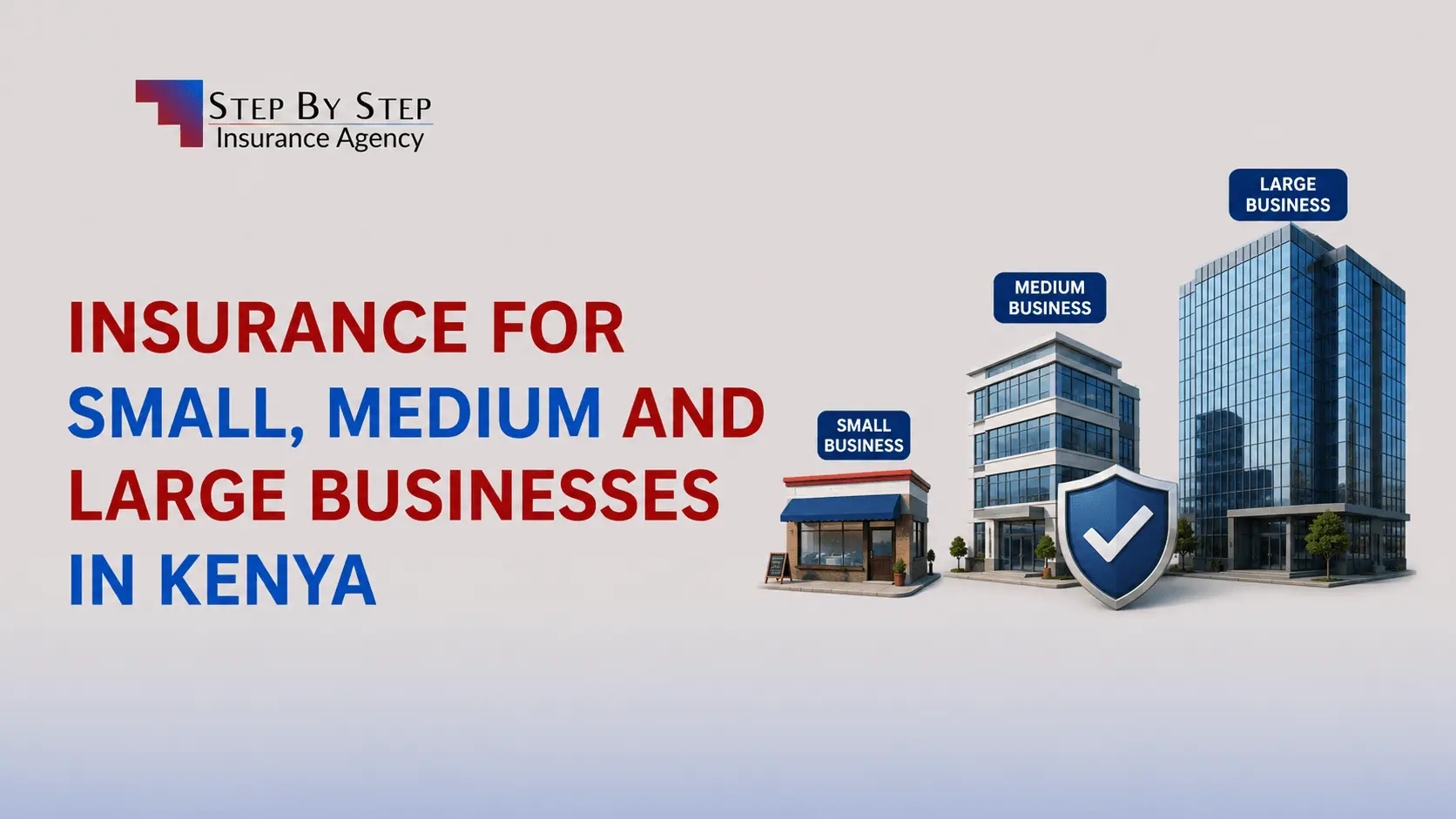
| Business Size | Common Risks | Insurance Priorities |
|---|---|---|
| Small Business | Fire, theft, employee injuries | Property, fire, burglary, WIBA, liability |
| Medium Business | Higher-value assets and operations | Property, liability, commercial motor, goods in transit |
| Large Business | Complex and high-value risks | Business interruption, employee benefits, engineering, professional liability |
The table above is only a general guide. The actual insurance needs of your business should be based on your specific operations and risk exposure.
Your Industry Also Determines the Insurance You Need
Business size is important, but industry matters too.
Retail Businesses
Retailers may consider: Fire insurance, burglary insurance, stock protection, money insurance and public liability.
Restaurants and Hospitality Businesses
These businesses may need to consider: Fire risks, kitchen equipment, public liability, employee-related risks and business interruption.
Manufacturing Businesses
Manufacturers may face risks involving: Fire, machinery, equipment breakdown, employee injuries and business interruption.
Construction Businesses
Construction companies may need specialised covers relating to: Contract works, plant and machinery, employee risks and third-party liability.
Professional Service Businesses
Consultants, accountants, IT companies, marketing agencies and other professional businesses may need to consider: Professional indemnity, office insurance, equipment protection and cyber-related risks.
Transport and Logistics Businesses
These businesses may consider: Commercial motor insurance, goods in transit, marine-related cover and employee protection.
How Much Does Business Insurance Cost in Kenya?
There is no single price for business insurance. The cost can depend on factors such as:
- The type of business
- Value of assets
- Number of employees
- Industry risks
- Type of cover required
- Claims history
- Location of the business
- Insurance limits selected
A small office may have completely different insurance requirements from a large manufacturing company. That is why comparing premiums alone is not always enough. A cheaper policy may have different limits, exclusions or conditions from another option. The goal should be to understand what you are buying, not simply find the lowest price.
Common Mistakes Businesses Make When Buying Insurance
1. Underinsuring Their Business
One of the biggest mistakes is declaring values that are too low. For example, if your stock has increased significantly but your insurance value has not been updated, you may not have sufficient protection. Step by Step Insurance recommends reviewing the replacement or rebuilding value of business property regularly because the value of construction, equipment and stock can change over time.
2. Choosing Insurance Based Only on Price
The cheapest premium is not automatically the best value. Always understand:
- What is covered
- What is excluded
- Policy limits
- Excesses
- Important conditions
3. Forgetting to Update Cover
Businesses grow. You may:
- Hire more employees
- Buy more equipment
- Increase stock
- Open another branch
- Add company vehicles
Your insurance should be reviewed when these changes happen.
4. Not Understanding the Policy
Insurance documents can sometimes feel complicated. Never assume something is covered simply because it sounds related to your business. Ask questions and understand the policy before purchasing.
Useful Internal Resources
Explore these helpful guides and services from Step by Step Insurance:
| Resource | Link |
|---|---|
| Fire Insurance Guide | How to Insure Your Business Premises Against Fire in Kenya |
| Office Insurance Options | Top Office Insurance Options in Kenya |
| Contact / Consultation | Request a Consultation |
| Get a Quote | Get a Quote |
| Call Us | +254 (0) 735 626 912 · +254 (0) 716 534 192 |
| 0722 888 350 |
How Step by Step Insurance Can Help Your Business
At Step by Step Insurance, we believe business insurance should not feel unnecessarily complicated. Whether you run a small biashara, an established SME or a large organisation, we can help you better understand the insurance options available for your business.
We Start by Understanding Your Business
Every business is different. We look at factors such as:
- Your industry
- Your operations
- Your assets
- Your employees
- Your existing insurance
- The risks your business faces
This helps create a clearer picture of the areas that may need protection.
We Help You Explore Relevant Insurance Options
Step by Step Insurance offers access to a range of insurance solutions, including Group Life, Marine Insurance, Commercial Motor and Professional Indemnity, among others. Depending on your needs, we can help you explore cover relating to:
- Business property
- Stock
- Employees
- Vehicles
- Professional services
- Goods in transit
- Workplace risks
We Help You Understand Your Policy
Buying insurance should not mean signing documents you do not understand. We aim to help explain important details such as:
- What the policy covers
- Important exclusions
- Insurance limits
- Policy conditions
- The claims process
Step by Step Insurance also provides claims guidance to help clients understand the process of reporting and following up on an insurance claim.
We Support You as Your Business Grows
Insurance should not be something you buy once and forget forever. As your business changes, your risks can change too. That is why reviewing your cover regularly can help ensure it continues to reflect your business.
Protect Your Business at Every Stage
Whether you are running a small shop, growing an SME or managing a large organisation, you have worked hard to build your business. A fire, burglary, workplace injury, liability claim or major disruption can create serious financial pressure.
The right insurance cannot prevent every unexpected event from happening. But it can help your business prepare for certain financial risks and recover from covered losses.
The most important step is understanding your risks before something goes wrong.
Talk to Step by Step Insurance
Not sure what insurance your business needs? At Step by Step Insurance, we can help you understand the risks facing your business and explore insurance options that fit your operations.
Talk to us today and take a step towards protecting what you have worked hard to build.